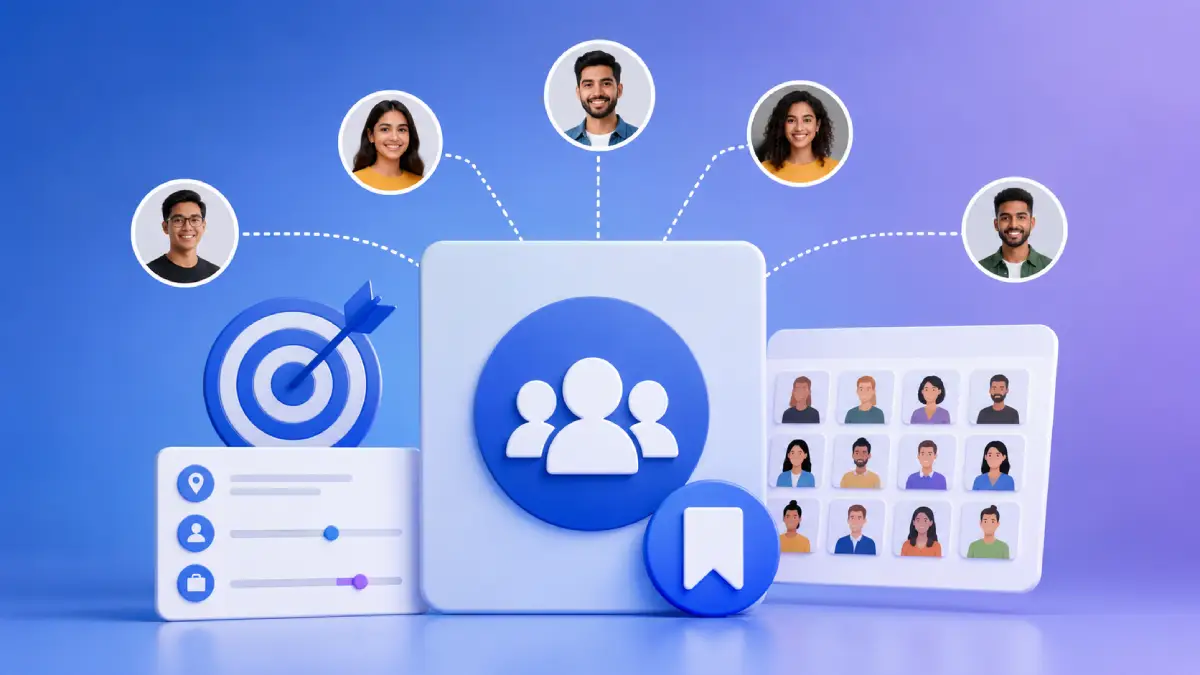
Saved Audience is a long-standing feature in Meta Ads Manager that allows advertisers to save an audience configuration and reuse it when creating future ad sets. It is primarily useful for organizing, reusing, and testing audience targeting setups. This guide explains what a Saved Audience is, what it contains, how it relates to other Meta audience options, and when it makes sense to use one.
1. What is a Saved Audience in Meta Ads?
A Saved Audience is a targeting configuration you build inside Ads Manager and save for reuse in future ad sets. Instead of rebuilding the same audience settings each time you create an ad set, you can select the saved configuration and apply it again.
A Saved Audience typically contains manually selected targeting settings such as:
- Location
- Age
- Gender
- Language
- Detailed targeting, including demographics, interests, and behaviors
Depending on the available setup, other audience-related settings may also be included. Saved Audiences can be accessed and managed from the Audiences section of Ads Manager, where available.
2. Why Use Saved Audiences?
Without Saved Audiences, advertisers may need to recreate the same targeting settings whenever they launch a new ad set. Saving an audience makes this process faster and can help maintain consistency across campaigns. Saved Audiences are also useful for testing different targeting ideas.
For example, an advertiser could create separate Saved Audiences for:
- Fitness enthusiasts
- Online shoppers
- Small business owners
- People in selected cities
- A broader prospecting audience
These configurations can then be reused when testing different creatives, offers, or campaign setups.
3. How Saved Audiences Work
3.1 What Gets Saved
A Saved Audience stores a reusable combination of audience targeting settings selected by the advertiser.
Depending on the available options, these may include:
- Location
- Age
- Gender
- Language
- Detailed targeting
- Demographics
- Interests
- Behaviors
- Other available audience settings
The exact settings available can vary depending on the campaign setup, account, location, and Meta’s current targeting options.
3.2 What It Doesn’t Save
A Saved Audience is primarily an audience configuration. It does not define the complete campaign or ad set setup.
Items such as the following are configured separately:
- Campaign objective
- Budget
- Bid strategy
- Placements
- Optimization settings
- Ad creative
- Ad copy
- Destination URL
For example, you could use the same Saved Audience in two ad sets while giving each ad set a different budget or creative.
4. Saved Audience and Core Audience Targeting
Saved Audience and Core Audience are related, but they are not the same thing.
- Core Audience refers to manually selected audience criteria such as location, demographics, and detailed targeting.
- Saved Audience allows a reusable audience configuration to be stored and applied again later.
For example, you could manually select:
Delhi + Age 25–45 + Fitness interests
and save those settings as a Saved Audience.
The Saved Audience is therefore a reusable targeting configuration, rather than a separate audience source like a Custom Audience or Lookalike Audience.
5. Is a Saved Audience a Cold Audience?
Saved Audiences are primarily used for cold prospecting because they typically use manually selected targeting criteria such as location, age, gender, language, demographics, interests, and behaviors.
For example:
People aged 25–45 in Delhi interested in fitness
This type of Saved Audience is generally considered a cold audience because it is based on targeting characteristics rather than previous interaction with the business.
However, Saved Audience describes how targeting settings are saved and reused; it is not itself a separate audience source.
This is different from:
- Custom Audience → built from an existing audience source, such as website visitors, customer lists, or engagement
- Lookalike Audience → finds new people similar to a source audience
- Saved Audience → saves a targeting configuration for reuse
Therefore, for practical purposes, Saved Audiences are most commonly associated with cold prospecting and manual targeting.
6. Saved Audience vs Other Meta Audience Types
6.1 Saved Audience vs Custom Audience
A Saved Audience is a reusable targeting configuration.
A Custom Audience is an audience created from a specific source, such as customer information, website activity, app activity, or engagement with Meta platforms.
For example:
Saved Audience: People aged 25–45 in Delhi interested in fitness
Custom Audience: People who visited your website in the last 30 days
The first is a reusable targeting configuration, while the second is an audience built from an existing audience source.
6.2 Saved Audience vs Lookalike Audience
A Saved Audience is based on saved targeting settings.
A Lookalike Audience is created from a source audience, such as customers, website visitors, or other eligible audiences, to find new people who are similar to that source.
For example:
Saved Audience: People aged 25–45 in Delhi interested in fitness
Lookalike Audience: People similar to your existing customer audience
The first relies on selected targeting inputs, while the second is based on an existing source audience.
6.3 Saved Audience vs Advantage+ Audience
Saved Audience and Advantage+ Audience serve different roles.
A Saved Audience allows an advertiser to save and reuse an audience configuration.
Advantage+ Audience uses Meta’s automated delivery system to find people who are likely to take the desired action. Audience information provided by the advertiser can be used as signals, while Meta may expand beyond some of those inputs when its system predicts better performance.
Meta also provides options to use Saved Audiences with certain Advantage+ Audience setups. This means a Saved Audience does not necessarily represent a strict boundary around who can receive the ad when Advantage+ Audience is active.
For example:
Saved Audience: A reusable configuration containing location, age, and other targeting inputs.
Advantage+ Audience: Meta can use those inputs as signals while using its automated system to identify additional people who may be more likely to respond.
The key distinction is:
Saved Audience is about saving and reusing targeting settings, while Advantage+ Audience is about how Meta uses audience inputs for delivery.
7. How Saved Audiences Fit Into Modern Meta Ads
Meta increasingly uses machine learning and automated delivery to determine which people are most likely to take the desired action. As a result, manually selected audience inputs do not always function as strict delivery boundaries, particularly when automated audience options are being used.
Saved Audiences therefore work primarily as reusable configurations for:
- Organizing targeting ideas
- Reusing audience setups
- Testing different audience hypotheses
- Maintaining consistency between ad sets
- Providing audience inputs to applicable campaign setups
This does not mean manual audience selection is irrelevant. Advertisers should understand whether their selected settings are acting as controls, signals, or part of a broader automated delivery system.
8. When Should You Use Saved Audience?
Saved Audience remains useful in several situations.
8.1 Local Businesses
A local business can save an audience targeting people within its service area and reuse the configuration across different campaigns.
For example:
A dental clinic could save an audience targeting people within its service area and use it for different promotional campaigns.
8.2 Niche Products
Saved Audiences can be useful when a product has a clearly defined customer profile.
For example:
A business selling professional photography equipment could save an audience based on relevant locations and available targeting signals.
8.3 Testing Audience Hypotheses
Advertisers can create different Saved Audiences to test different targeting ideas.
For example:
Audience A → Fitness interests
Audience B → Online shoppers
Audience C → Broader demographic targeting
This makes it easier to compare different audience approaches.
8.4 Traffic and Content Promotion
Saved Audiences can also be useful when promoting blog posts, educational content, or other resources to new prospects.
8.5 Reusing Standard Targeting Configurations
If a business regularly uses similar targeting settings, saving the configuration can reduce repetitive setup work and improve consistency.
8.6 Campaigns With Specific Targeting Requirements
Saved Audiences can be useful where specific audience controls remain available and appropriate. However, available targeting options may be restricted for Special Ad Categories and other advertising situations.
9. Best Practices for Saved Audiences
9.1 Use Real Customer Research
Build audience configurations around what you know about your customers rather than simply selecting interests that appear relevant.
9.2 Avoid Unnecessary Narrowing
Do not add large numbers of targeting conditions simply to make an audience appear more specific. Extremely narrow audiences can restrict delivery and reduce the available pool of potential customers.
9.3 Test Different Audience Hypotheses
Instead of assuming one audience will perform best, test different reasonable audience approaches when appropriate.
For example:
Broad targeting vs interest-based targeting vs another relevant targeting configuration
9.4 Review Saved Audiences Regularly
Meta continuously changes its available targeting options. Review saved configurations periodically to make sure their settings are still relevant and available.
9.5 Do Not Treat Interests as Purchase Intent
An interest indicates a potential connection with a topic or category. It does not necessarily mean that a person intends to purchase a product.
9.6 Combine Audience Inputs With Strong Creative
Audience selection alone does not determine campaign performance. Strong creative, a clear offer, and an appropriate campaign setup are also important.
10. Common Saved Audience Mistakes
- Stacking Too Many Interests: Adding many interests does not automatically create a better audience. It can make the audience unnecessarily restrictive.
- Assuming Interest Means Purchase Intent: Someone interested in a topic may not be ready to buy a related product.
- Making the Audience Too Narrow: Very restricted audiences can limit delivery and reduce Meta’s ability to find enough potential customers.
- Treating a Saved Audience as a Fixed List of People: A Saved Audience is a saved targeting configuration, not a permanent list of individual users. This makes it different from a Custom Audience, which represents people identified from a particular audience source.
- Never Reviewing Saved Configurations: Targeting options can change or become unavailable. Old Saved Audiences should therefore be reviewed periodically.
- Assuming Saved Audience Always Acts as a Strict Boundary: When automated audience options such as Advantage+ Audience are used, some audience inputs may function as signals rather than strict limitations.
11. Saved Audience in a Modern Meta Ads Strategy
Saved Audience should be viewed as one part of a broader audience strategy. It can help advertisers organize and reuse targeting configurations, while Custom Audiences can provide valuable first-party audience signals and Lookalike Audiences can help find new people based on an existing source audience.
Advantage+ Audience adds another layer of automated audience delivery, allowing Meta’s system to use advertiser-provided audience information while looking for people who are more likely to achieve the selected campaign outcome.
The right approach depends on the campaign, available audience data, targeting requirements, and the level of automation being used.
12. Conclusion
Saved Audience remains a practical feature inside Meta Ads Manager for saving, organizing, testing, and reusing audience targeting configurations. It should not be confused with Custom Audiences, Lookalike Audiences, or Advantage+ Audience because each serves a different purpose.
The key idea is simple:
Saved Audience saves audience targeting settings for reuse.
Saved Audiences are primarily useful for cold prospecting and manual targeting configurations, while Custom Audiences and Lookalike Audiences are based on existing audience sources. At the same time, advertisers should understand how Saved Audience settings can interact with Meta’s automated audience and delivery systems.