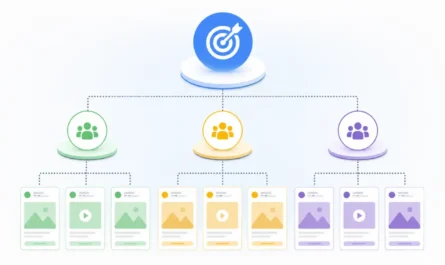

Advantage+ Audience has quietly become one of the biggest shifts in how Meta Ads actually work, and most advertisers still treat it like an optional toggle rather than the new default it has become. If you have logged into Ads Manager recently and noticed that your old targeting fields now feel like suggestions rather than rules, you are not imagining things that is the AI doing exactly what it was built to do.
For years, running a Facebook or Instagram campaign meant manually stacking interests, narrowing age brackets, and guessing which demographic combination would convert best. That process worked, but it relied heavily on human intuition and constant testing. Meta introduced AI-powered targeting to remove much of that guesswork, letting its machine learning models analyze billions of signals across the platform to find people who are actually likely to buy, sign up, or engage often people an advertiser would never have thought to target manually.
The shift from manual targeting to AI-assisted optimization did not happen overnight. It evolved gradually from optional audience expansion features into Advantage+ Audience, which is now the default audience experience for many campaign setups where the feature is available. Depending on your campaign objective, account, and Meta’s ongoing rollouts, you may find Advantage+ Audience enabled automatically when creating a new ad set, while other campaigns may still offer more traditional audience options.
1. What Is Advantage+ Audience?
Advantage+ Audience is Meta’s AI-powered audience targeting setting that helps determine who sees your ads based on real-time signals and machine learning predictions rather than relying only on fixed audience criteria. Unlike Custom Audiences, Lookalike Audiences, or Saved Audiences, it is not an audience type that you create and reuse. Instead, it is a targeting setting within the Audience section of the ad set that changes how Meta uses the audience information you provide during ad delivery. Meta introduced Advantage+ Audience as part of its broader shift toward AI-driven advertising, allowing its delivery system to identify people who are likely to complete your campaign objective by analyzing a much wider range of signals than manual targeting alone could provide.
2. How Advantage+ Audience Works
2.1 AI-Powered Audience Targeting
At its core, Meta’s AI analyzes a wide range of signals, including user engagement, advertiser-provided conversion signals, website and app activity where available, and historical campaign performance, along with other signals available within Meta’s advertising ecosystem, to predict who is most likely to take the action your campaign is optimized for.
There is an important distinction between audience suggestions and audience controls. Suggestions guide the algorithm toward your ideal customer profile without boxing it in, while controls act as hard limits the system will not cross. This optimization continues after a campaign launches; Meta keeps adjusting delivery as new performance signals become available and as the system learns which people are more likely to complete the desired action.
2.2 Audience Suggestions
You can still provide information to help guide Meta’s AI, but these inputs are generally treated as audience suggestions rather than strict targeting rules. Depending on your campaign and available options, you can provide signals such as:
- Interests and detailed targeting related to your product or niche
- Age and gender preferences, where available within the campaign setup
- Custom Audiences built from existing customers or website visitors
- Lookalike Audiences modeled on your existing audiences
Meta uses these suggestions as a starting point when finding people who are likely to achieve your campaign objective, while remaining free to expand beyond them when doing so is expected to improve performance. Feeding the system strong first-party data, such as a well-built Custom Audience, generally produces better results than relying on interests alone.
3. Audience Controls
Unlike suggestions, a small set of settings remain firm rules that Meta will not override, regardless of how the AI wants to expand delivery:
- Location targeting
- Minimum age requirements
- Language preferences
- Audience exclusions you set manually
These controls help advertisers maintain important business, compliance, and targeting requirements while still allowing Meta’s AI to optimize delivery beyond the audience suggestions you provide.
4. Where to Find Advantage+ Audience
Advantage+ Audience appears at the ad set level within the Audience section of Ads Manager. For many campaign objectives where it is available, Meta applies it automatically when you create a new ad set, although the exact experience can vary depending on your campaign objective, account eligibility, and Meta’s ongoing feature rollouts. If manual audience options are available, you may also see the option to switch back to the original audience experience.
The basic setup workflow involves selecting your campaign objective, moving to the ad set level, reviewing the Audience section where Advantage+ Audience is likely already enabled, and then adding any suggestions interests, Custom Audiences, or Lookalikes before setting your non-negotiable controls like location and age.
5. Benefits of Advantage+ Audience
- Simplifies Audience Setup: Reduces the need for extensive manual targeting and complex interest stacking before launching campaigns.
- Helps Find More Relevant People: Uses Meta’s AI and a broader range of signals to identify users who are more likely to take the desired action.
- Supports Campaign Scaling: Allows campaigns to reach additional potential customers without being limited by narrow audience definitions.
- Continuously Learns and Optimizes: Adjusts delivery based on campaign performance and new signals instead of relying on a fixed audience setup.
- Reduces Manual Guesswork: Helps advertisers move away from trial-and-error targeting decisions and rely more on AI-powered optimization.
6. Limitations of Advantage+ Audience
None of this comes without trade-offs. Advertisers hand over a meaningful amount of manual control, which can feel uncomfortable for anyone used to precise targeting. Results also depend heavily on the quality of the signals you provide weak or thin conversion data gives the algorithm less to work with, and performance suffers as a result.
Performance itself varies noticeably depending on the objective and the account’s history; newer accounts or those with low conversion volume often see less consistent results during the learning phase. It is also not the ideal choice for campaigns with highly restrictive targeting needs, such as niche B2B offers or legally sensitive categories where broad reach could create compliance issues.
7. Best Practices
A few habits separate advertisers who get strong results from those who struggle:
- Feed the algorithm high-quality audience suggestions rather than vague or outdated ones
- Set up accurate conversion tracking so the AI has reliable data to learn from
- Avoid creating an overly restrictive audience by combining too many limitations, as this can reduce the AI’s ability to find qualified people and optimize campaign performance
- Give new campaigns enough time to exit the learning phase before judging performance
- Prioritize strong creative and compelling offers, since with targeting largely automated, ad quality becomes the biggest lever advertisers still control directly
8. Common Misconceptions
A few myths persist around this feature. Some advertisers assume Advantage+ Audience completely ignores their targeting input, when in reality it uses that input as a strong starting signal rather than discarding it. Others believe interests no longer matter at all, but they still shape the algorithm’s starting direction even if they are not strict filters anymore.
There is also a common assumption that broader targeting always outperforms narrower targeting, which is not universally true results depend on budget, conversion volume, and how well the campaign is structured. Finally, some believe this feature replaces Custom or Lookalike Audiences entirely, but those audience types remain valuable inputs that strengthen, rather than get replaced by, the AI system.
9. Conclusion
Advantage+ Audience represents a genuine shift in how Meta advertising works, moving targeting decisions away from rigid manual rules and toward an AI system that continuously learns from real performance data. It is not a new audience category to choose between it is a setting that reshapes how your existing suggestions, exclusions, and audience data get used during delivery.
The advertisers seeing the strongest results are not the ones fighting the algorithm, nor the ones blindly trusting it without oversight. They are the ones feeding it clean data, solid creative, and clear conversion signals, while still keeping firm control over the few settings, like location and age, that genuinely need to stay fixed. Combining quality inputs with Meta’s AI, rather than choosing one over the other, is what tends to produce the best outcomes going forward.
10. Frequently Asked Questions
Is Advantage+ Audience enabled by default?
For many campaign objectives where Advantage+ Audience is available, it is often enabled automatically when you create a new ad set. The exact experience can vary depending on your campaign objective, account, and Meta’s ongoing feature rollouts.
Can I still use interests?
Yes, they remain usable as suggestions that help guide, rather than restrict, the algorithm.
Can I use Custom Audiences?
Yes, and they are considered one of the stronger signals you can provide.
Can I use Lookalike Audiences?
Yes, Lookalikes continue to function as valuable suggestion inputs.
Can I turn Advantage+ Audience off?
On objectives that still permit it, you can switch back to original, more manual audience settings within the ad set.
Does it work with every campaign objective?
No, availability depends on the specific objective, and some retain more manual targeting options than others.