
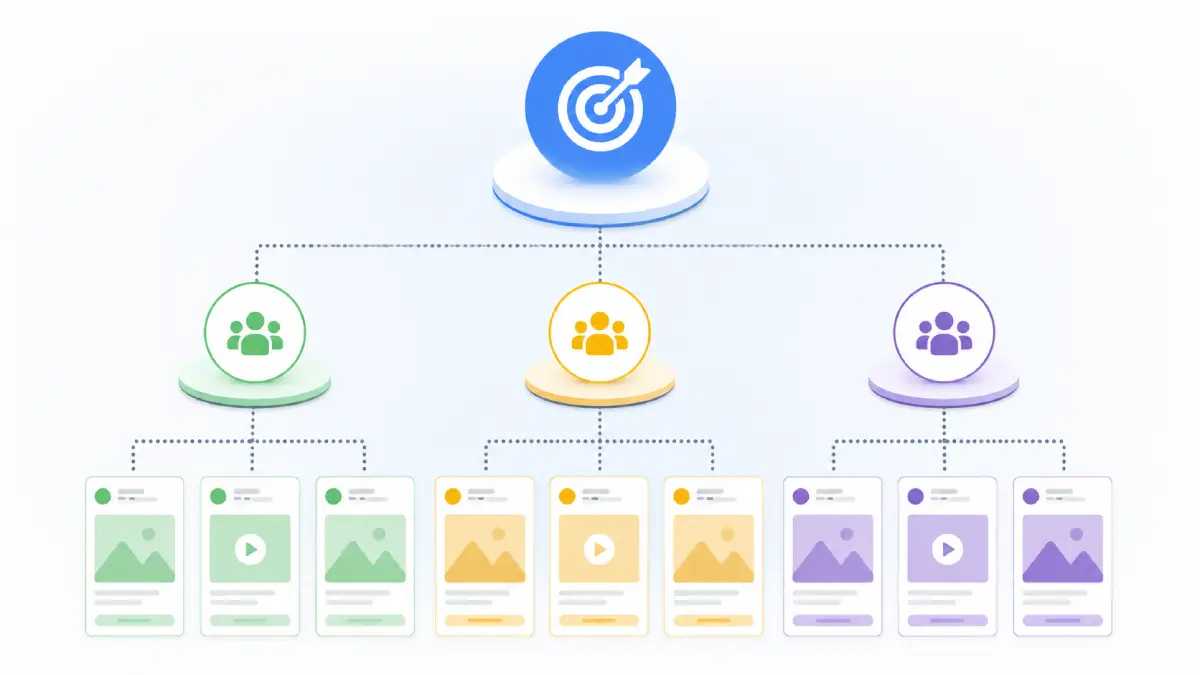
If you’ve ever opened Ads Manager and felt a little lost between all the tabs, columns, and toggles, you’re not alone. Facebook’s advertising system is built on a hierarchy, and once that hierarchy clicks, everything else budgets, targeting, creative testing starts to make a lot more sense. This guide explains how the Facebook Ads structure works, what each level controls, and how to organize your campaigns for easier management, testing, and optimization.
Getting this right matters more than it might seem. A well-organized account gives Meta cleaner signals to optimize around, makes your reporting easier to read, and helps prevent unnecessary overlap between campaigns targeting similar audiences.
1. The Three Levels of Facebook Ads
Every Facebook ad account is built on three layers that sit inside one another like nested boxes:
- Campaign: The top level, where you set your objective
- Ad Set: The middle level, where you define audience, budget, schedule, and placement
- Ad: The bottom level, where the actual creative lives
Each campaign can hold multiple ad sets, and each ad set can hold multiple ads. This nesting is what lets Meta test different audiences and creatives without you having to build a separate campaign for every combination.
2. Campaign Level: Objectives, Budget & Key Settings
The campaign is where you tell Meta what outcome you’re chasing leads, sales, traffic, app installs, and so on. This single choice shapes everything downstream, including what optimization options show up at the ad set level.
Meta continues to simplify campaign creation by integrating more Advantage+ automation into its standard campaign setup. Depending on your campaign objective and account, automated recommendations and settings may be enabled by default to help improve performance.
Budget at the campaign level usually means Advantage+ Campaign Budget (previously called Campaign Budget Optimization). You set one overall campaign budget, and Meta automatically distributes spend across ad sets based on which ones are more likely to achieve your desired result. You can still set minimums or maximums per ad set if you want some control over how far spend can shift.
Campaign spending limit is a separate setting worth knowing. It’s a hard cap on total spend for the whole campaign once it’s hit, delivery stops completely. This is different from a daily budget, which resets each day; a spending limit is a one-time ceiling for the campaign’s entire lifetime.
A simple naming convention objective, audience, and date makes a big difference once your account has more than a couple of campaigns running.
3. Ad Set Level: Audience, Budget, and Delivery
This is where targeting, budget, scheduling, and placement decisions happen.
Audience targeting has evolved to rely more on automation. Meta encourages advertisers to use Advantage+ Audience, which uses your audience suggestions as a starting point and may expand delivery when its system predicts better results. You can still define audience controls such as location, minimum age, language, and exclusions where needed, while Meta optimizes delivery to reach people most likely to achieve your campaign objective.
Budget can also be set here instead of at the campaign level. This is the more manual approach you leave the campaign-level budget option off and set a daily or lifetime budget directly inside each ad set. One thing to keep in mind: a daily budget is treated as an average by Meta, so it’s normal to see spend run somewhat higher than your set number on days with strong opportunity, and lower on others.
Advantage+ Placements automatically selects the most effective placements across Facebook, Instagram, Messenger, and the Audience Network. You can also choose Manual Placements if you want greater control over where your ads appear.
4. Ad Level: Where the Creative Lives
An individual ad contains the creative elements that people see, including the image or video, primary text, headline, description, call-to-action (CTA), and destination URL.
You’ll also add tracking through the Meta Pixel to measure actions people take after interacting with your ad, such as purchases, form submissions, or registrations. This data helps Meta measure campaign performance and optimize delivery toward people who are more likely to complete your desired action.
This ad level is also where creative testing happens. Rather than building a new ad set for every creative idea, it usually works better to load a few different creative angles into one ad set and let delivery sort out which one performs best.
5. How the Hierarchy Works Together
Think of it as a simple flow of decisions. The campaign decides the goal. The ad set decides who sees the ad, how much gets spent, and where it appears. The ad decides what that person actually sees. Because these layers feed into each other, mixing objectives or audiences carelessly across levels tends to create confusing, hard-to-read results.
6. Structure Examples in Practice
Lead generation setup: One campaign built around the Leads objective, with one or two ad sets using broad or Advantage+ audiences, each running three to four ads with different angles a benefit-driven ad, a testimonial-style ad, and an offer-based ad.
Sales-focused setup: A prospecting campaign with broad targeting, paired with a smaller retargeting campaign for warm traffic like website visitors or people who added items to cart but didn’t buy. Retargeting is usually kept simple one or two ad sets and only split further once there’s enough traffic to justify it.
7. Best Practices for Keeping Things Organized
- Use consistent naming across campaigns, ad sets, and ads
- Build one campaign per objective, rather than several similar campaigns competing with each other
- Change one variable at a time within an ad set audience, creative, or placement so you can tell what actually made a difference
- Give each ad set a handful of creative variations instead of testing with just one ad
- Avoid running ad sets that target overlapping audiences, since they’ll end up bidding against each other
- When increasing budget, do it gradually small increases spaced out over a few days work better than big jumps, which can disrupt delivery
8. Common Mistakes That Hurt Performance
- Creating too many campaigns chasing the same goal, which splits budget and data unnecessarily
- Mixing different, unrelated audiences inside one ad set
- Testing with only one ad, leaving nothing to compare it against
- Editing live ads too frequently, which can reset delivery and slow things down
- Vague or inconsistent naming, which makes the account harder to manage as it grows
9. How Facebook Ads Structure Improves Campaign Performance
A well-organized Facebook Ads structure does more than keep your account tidy, it also helps improve campaign management and optimization.
Reduced audience overlap: Properly structured ad sets help minimize competition between your own ads.
Better budget allocation: Budgets are distributed more effectively across campaigns or ad sets based on your chosen strategy.
Easier performance analysis: A clear structure makes it easier to identify which audiences and ads perform best.
Improved creative testing: Multiple ads within an ad set allow you to compare different creatives and messaging.
Simplified account management: Organized campaigns are easier to monitor, optimize, and scale over time.
10. Bringing It All Together
The three-level structure Campaign, Ad Set, and Ad forms the foundation of every Facebook advertising campaign. Understanding how each level works helps you organize your account, manage budgets more effectively, reach the right audience, and test creatives with confidence. For most advertisers, keeping the structure simple one campaign per objective, one or two well-organized ad sets, and multiple creative variations makes campaigns easier to optimize, analyze, and scale over time.
11. Frequently Asked Questions
What are the three levels of Facebook Ads structure?
Campaign, Ad Set, and Ad each nested inside the one above it.
What is a Campaign in Facebook Ads?
The top-level container where you choose your advertising objective, such as leads, sales, or traffic.
What is an Ad Set in Facebook Ads?
The layer that controls audience, budget, schedule, and placements.
What is an Ad in Facebook Ads?
The actual creative media, copy, and call-to-action that people see.
How do Campaign, Ad Set, and Ad work together?
The campaign sets the goal, the ad set defines who sees it and how spend is allocated, and the ad delivers the message.
Can one Campaign have multiple Ad Sets?
Yes, and this is common when testing different audiences or splitting prospecting from retargeting.
Can one Ad Set contain multiple Ads?
Yes, running three to four creative variations per ad set is standard practice.
What’s the difference between Campaign Budget and Ad Set Budget?
Campaign budget lets Meta shift spend automatically across ad sets; ad set budget gives you fixed, manual control per audience.
Which level controls audience targeting?
The Ad Set level.
Which level controls the ad creative?
The Ad level.
Can I edit a Campaign after it’s published?
Yes, though frequent edits, especially to live ads can slow delivery down temporarily.
Can I duplicate a Campaign, Ad Set, or Ad?
Yes, duplication is available and often used to test variations without rebuilding from scratch.
How many Campaigns should I create?
Generally one per objective, rather than multiple campaigns chasing the same goal.
How many Ads should I have in one Ad Set?
Three to four is a common range for meaningful creative testing.
What happens if I delete an Ad Set?
Its ads stop running, and while you can’t edit its historical data further, reporting usually stays accessible.
What’s the best structure for beginners?
One campaign per objective, one or two ad sets with broad or Advantage+ targeting, and a handful of ads for creative testing.
Does changing one level affect the others?
Yes. The Campaign, Ad Set, and Ad levels work together. For example, changing a campaign objective can affect available optimization options, while editing an Ad only changes that specific creative.
Should I create separate campaigns for every audience?
No. Creating too many campaigns can split your budget and data. In most cases, it is better to organize audiences within ad sets unless there is a clear reason to separate campaigns.
What is the difference between Campaign, Ad Set, and Ad?
The Campaign defines the goal, the Ad Set controls targeting, budget, and placements, and the Ad contains the creative users see.
What is the best Facebook Ads structure for beginners?
A simple structure works best for beginners: one campaign per objective, one or two ad sets with broad or Advantage+ targeting, and multiple ads to test different creatives.