
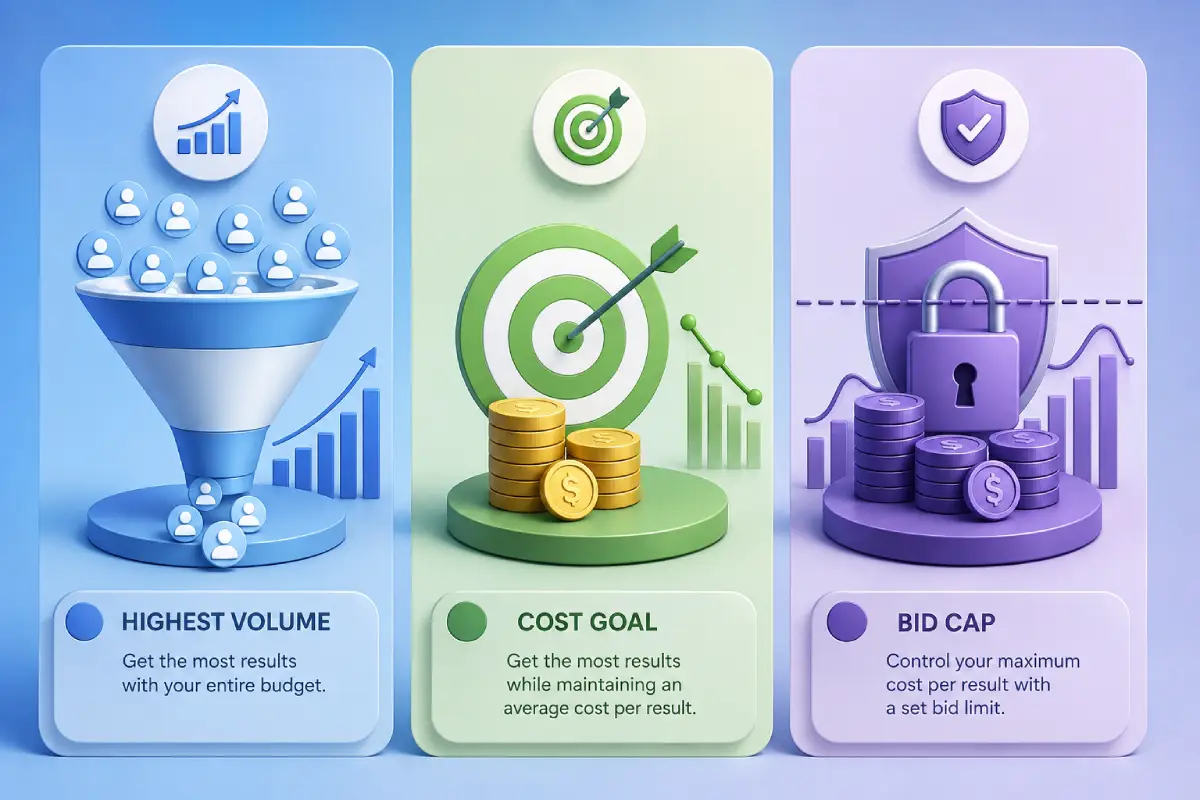
Meta’s advertising auction is one of the most sophisticated systems in digital marketing, yet many advertisers launch campaigns without fully understanding one of the key controls that influences how Meta competes for impressions: the bidding strategy. Choosing a budget and audience is only part of campaign setup. Your bidding strategy influences how Meta competes in auctions and balances delivery, cost, and results.
The three bidding strategies covered in this article are Highest Volume, Cost Per Result Goal, and Bid Cap. Meta can show different bidding options depending on the campaign objective, performance goal, optimization event, and other campaign settings. It’s also important to separate three concepts that are often bundled together: budget, bid strategy, and cost controls.
Budget determines how much you are willing to spend, either daily or over the campaign’s lifetime. Bid strategy tells Meta how to compete in auctions based on your preferred outcome. Cost controls are numeric settings attached to certain strategies, such as a target cost or maximum bid.
Every impression Meta serves goes through an auction. Your bidding strategy works alongside factors such as estimated action rate and ad quality to determine the overall value of your ad in that auction.
1. What is a Bidding Strategy in Meta Ads?
A bidding strategy is essentially the instruction you give Meta for how to behave inside its ad auctions. Every time a user reaches a placement where your ad is eligible to appear, Meta runs an auction in milliseconds, evaluating eligible advertisers against one another. Your bidding strategy tells the system what you care about most: getting as many results as possible, maintaining an average cost around a target, or applying a maximum bid limit.
This choice affects how Meta uses your budget, which auction opportunities it pursues, and how much delivery you may receive. A less restrictive strategy generally gives Meta more flexibility to find results, while stricter controls can limit the number of auction opportunities available to the system.
Meta evaluates each auction opportunity using multiple signals, including the advertiser’s bid, estimated action rate, and ad quality. This means a higher bid does not always win because the overall value of showing an ad also depends on expected user response and ad experience.
2. Where to Find Bidding Strategy in Meta Ads Manager
Bidding strategy settings are generally found during Ad Set setup, usually within the Optimization and Delivery section. However, available bidding options and their exact placement can vary depending on the campaign objective, performance goal, optimization event, conversion location, and Meta Ads interface.
The campaign setup determines which bidding strategies are available. For example, a traffic campaign may not offer the same bidding options as a purchase-focused campaign. Therefore, the options you see in Ads Manager can differ depending on the campaign configuration.
3. Highest Volume Bidding Strategy
Highest Volume is Meta’s automated bidding approach designed to generate as many results as possible from the available budget. There is no specific cost target applied. Instead, Meta automatically adjusts its bidding based on available auction opportunities and predicted results.
For example, imagine you have a daily budget of ₹5,000 and are optimizing for purchases or leads. Meta will aim to use the available budget to generate as many of those results as possible, subject to auction opportunities and campaign delivery conditions. The main advantage of Highest Volume is that it gives Meta maximum flexibility to find conversion opportunities.
Because there is no predefined cost target or auction-level bid limit, Meta can compete across a wider range of opportunities. This can make it a practical starting point when you do not yet have enough reliable performance data to establish a realistic cost target. However, your cost per result can fluctuate because the strategy does not attempt to maintain a specific average cost.
Best suited for:
- New campaigns
- Testing new audiences and creatives
- Advertisers with limited historical performance data
- Campaigns focused on increasing result volume
- Situations where delivery flexibility is more important than a specific cost target
The tradeoff is reduced cost control. Your cost per result can move higher or lower depending on auction competition, audience behavior, conversion rates, and other delivery conditions.
4. Cost Per Result Goal Bidding Strategy
Cost Per Result Goal allows advertisers to provide Meta with a target average cost for the desired result. Rather than focusing only on maximizing volume, Meta attempts to deliver results while keeping the average cost around the target you provide.
For example, if your target cost per lead is ₹500, individual leads may cost ₹400, ₹500, or ₹600. The target is intended to guide the average cost rather than guarantee that every individual result costs ₹500. This approach can provide more cost control for advertisers who already understand their typical acquisition costs. It works best when the target is realistic and supported by reliable historical performance data.
Setting an overly aggressive cost target can reduce delivery because Meta may have fewer auction opportunities that fit the target. For example, if your campaigns normally generate leads at around ₹500 but you set a Cost Per Result Goal of ₹200, Meta may struggle to find enough opportunities to deliver your desired volume. Advertisers should therefore consider historical campaign performance, conversion data, and their business economics when deciding on a target.
Best suited for:
- Campaigns with consistent performance
- Advertisers who understand their average cost per result
- Businesses with a clear acquisition-cost target
- Situations where cost efficiency is important
The key point is that Cost Per Result Goal is an average cost target, not a maximum cost for every individual result.
5. Bid Cap Bidding Strategy
Bid Cap gives advertisers more manual control by setting the maximum amount Meta can bid in an auction. Unlike Cost Per Result Goal, which is intended to guide the average cost per result, Bid Cap applies at the auction bidding level.
For example, if you set a Bid Cap of ₹300, Meta will use ₹300 as the maximum bid it can make in an auction under that strategy. However, this does not guarantee that your final cost per result will be ₹300. Your actual cost per result can still depend on auction competition, estimated action rates, conversion rates, and other delivery factors.
Bid Cap provides a high level of manual control, but that control can also restrict delivery. If the bid cap is set too low compared with what is required to compete effectively in available auctions, Meta may have fewer opportunities to deliver your ads. This can result in underspending or limited results. Bid Cap is therefore generally better suited to advertisers who understand their market costs, auction conditions, and campaign performance well.
Best suited for:
- Advertisers who need strict auction-level bidding control
- Campaigns with clear auction benchmarks
- Experienced advertisers managing advanced bidding requirements
- Situations where controlling the maximum bid is important
Bid Cap is not usually the best starting point when you do not yet understand what competitive bids are required to generate results.
6. Highest Volume vs Cost Per Result Goal vs Bid Cap
| Bidding Strategy | Control Level | Delivery Flexibility | Data Requirement |
|---|---|---|---|
| Highest Volume | Lowest | Highest | Lower |
| Cost Per Result Goal | Moderate | Moderate | More historical performance data is helpful |
| Bid Cap | Highest | Most restricted by the bid limit | Strong auction and campaign knowledge |
6.1 Control Level
Highest Volume
- Lowest manual control
- Maximum flexibility for Meta’s delivery system
Cost Per Result Goal
- Moderate control
- Provides an average cost target while allowing Meta to manage auction bidding
Bid Cap
- Highest manual control
- Places a maximum limit on the auction bid
6.2 Delivery Potential
Highest Volume: Designed to maximize available results within the budget.
Cost Per Result Goal: Attempts to maintain average costs around the specified target.
Bid Cap: Delivery depends heavily on whether the bid limit is competitive enough for available auctions.
6.3 Data Requirement
Highest Volume: Can be used when historical performance data is limited.
Cost Per Result Goal: Works better when you have reliable historical cost data.
Bid Cap: Generally requires stronger knowledge of auction conditions and campaign performance.
7. How to Choose the Right Meta Ads Bidding Strategy
The right bidding strategy depends on your campaign maturity, available data, business economics, and how much control you need over bidding and costs.
7.1 Choose Highest Volume When:
- Launching a new campaign
- Testing new audiences or creatives
- You want to maximize result volume
- You have limited historical performance data
- You do not have a reliable cost target yet
7.2 Choose Cost Per Result Goal When:
- You understand your average cost per result
- Your campaign has consistent performance
- Maintaining cost efficiency is important
- You have enough historical data to set a realistic target
7.3 Choose Bid Cap When:
- You need strict control over auction bidding
- You understand your market and auction costs
- You have reliable campaign benchmarks
- You have experience managing advanced bidding strategies
For many advertisers, Highest Volume is the simplest starting point because it does not require a predefined cost target. Once reliable performance data is available and there is a genuine need to guide average costs, Cost Per Result Goal can be considered. Bid Cap is generally more appropriate when there is a specific reason to control the maximum auction bid and the advertiser understands the effect that restriction can have on delivery.
8. Common Mistakes With Meta Ads Bidding Strategies
One of the most common mistakes is setting a Cost Per Result Goal based on an unrealistic expectation rather than previous campaign performance. An overly aggressive target can restrict delivery and reduce the number of available opportunities. Another common mistake is using Bid Cap too early, before understanding what the auction realistically requires. A restrictive bid can make it difficult for Meta to compete effectively.
Switching bidding strategies too frequently is another problem. Significant changes to bidding conditions can affect delivery stability and make it difficult to determine whether performance changed because of the strategy or other campaign factors. Finally, many advertisers expect bidding alone to fix underlying campaign problems. Weak creative, a poorly matched audience, an unclear offer, or inaccurate tracking can undermine performance regardless of the bidding strategy being used.
9. Best Practices for Meta Ads Bidding
Start with a bidding strategy that matches the amount of data and control you actually have. For many campaigns, Highest Volume provides the flexibility needed to gather performance data without introducing an additional cost or bid restriction. Once you understand your typical cost per result, Cost Per Result Goal can be considered when maintaining an average acquisition cost is important. Bid Cap should generally be used when you have a clear reason to control auction-level bidding and enough knowledge to set a competitive limit.
When evaluating a bidding strategy, monitor:
- Cost per result
- Total results and conversion volume
- Delivery status and signs of restrictions
- ROAS where relevant
- Learning status after significant changes
Avoid changing bidding strategies simply because of short-term fluctuations. Evaluate performance over enough data to understand whether the strategy is actually affecting results.
10. Conclusion
Meta Ads bidding strategies influence how the platform competes for your ads in each auction.
Highest Volume focuses on generating as many results as possible within the available budget.
Cost Per Result Goal provides Meta with a target average cost per result.
Bid Cap gives advertisers greater control over the maximum amount Meta can bid in an auction.
The right choice depends on your campaign objective, performance goal, available data, business economics, and required level of control.
For advertisers who want maximum delivery flexibility, Highest Volume is often the simplest approach. When reliable cost benchmarks are available, Cost Per Result Goal can provide greater control over average acquisition costs. Bid Cap is best reserved for situations where auction-level bidding control is genuinely required and the advertiser understands the potential impact on delivery.