

Meta’s advertising system has increasingly shifted from manually defining exactly who to target toward providing signals that help its delivery system find people who are likely to respond. Advantage+ Detailed Targeting sits within this broader shift. If you’ve noticed your campaigns reaching people beyond the interests you selected, this can be one reason. This article explains what Advantage+ Detailed Targeting is, how it works, how the setting behaves, and what advertisers should keep in mind.
1. What Is Advantage+ Detailed Targeting?
Advantage+ Detailed Targeting is a feature that allows Meta’s ad delivery system to reach people beyond the specific interests, behaviors, and demographics an advertiser selects in Detailed Targeting. Instead of always treating those selections as strict limits, Meta can use them as signals to understand the type of audience that may be relevant to the campaign.
Based on these signals and other available information, Meta can evaluate additional people who weren’t explicitly included in the original selections. The underlying goal is to find people who are more likely to complete the action the campaign is optimized for, such as making a purchase, submitting a lead, or installing an app.
Previous terminology: Meta has used different names for this audience-expansion functionality over time, including Detailed Targeting Expansion and Advantage Detailed Targeting. The current terminology is Advantage+ Detailed Targeting. Older Meta Ads tutorials and resources may therefore use these earlier terms when describing the ability to expand beyond selected Detailed Targeting.
2. How Advantage+ Detailed Targeting Works
The process generally follows a straightforward sequence. An advertiser selects Detailed Targeting inputs, and Meta’s system uses those inputs as a starting point rather than necessarily treating them as a fixed boundary.
From there, the system can evaluate a broader pool of potential users and expand delivery beyond the original selections when it predicts that doing so may improve performance. Meta continuously optimizes delivery based on the campaign’s performance goal. This means the audience your ad actually reaches may be broader than the audience you originally defined through Detailed Targeting.
3. Detailed Targeting as an Audience Signal
Interests, demographics, and behaviors selected in Detailed Targeting still provide useful information, but their role can be less restrictive when audience expansion is enabled.
An interest such as hiking gear, for example, can provide Meta with information about the type of audience you want to reach. However, it does not necessarily mean that delivery will be limited only to people associated with that interest.
The system can use these inputs as signals while evaluating a broader pool of potential users based on the campaign’s performance goal.
4. What Advantage+ Detailed Targeting Can Expand Beyond
It’s important to be precise here. Advantage+ Detailed Targeting specifically concerns the Detailed Targeting inputs provided by the advertiser, such as available interests, demographics, and behaviors.
It should not be interpreted as permission for Meta to ignore every audience setting in the campaign. Other audience settings can have different roles depending on the campaign setup. For example, some settings can act as audience controls or restrictions, while others can function as suggestions. Understanding this distinction helps advertisers avoid assuming that every audience setting can be expanded in the same way.
5. Advantage+ Detailed Targeting Example
Imagine a business selling ergonomic office chairs that selects Home Office and Remote Work as Detailed Targeting interests.
If Meta’s system predicts that people interested in productivity tools or standing desks are also likely to respond to the ad, it may deliver the ad to some of those people even though the advertiser did not manually select those interests. The advertiser provided the initial audience signals, while Meta’s delivery system identified an additional opportunity based on its predictions.
6. Advantage+ Detailed Targeting vs. Detailed Targeting
The difference between these two comes down to flexibility.
- Detailed Targeting is where advertisers select available interests, behaviors, or demographics to provide audience inputs.
- Advantage+ Detailed Targeting gives Meta more flexibility to deliver ads beyond those specific selections when its system predicts that doing so may improve performance.
In simple terms, Detailed Targeting provides the starting inputs, while Advantage+ Detailed Targeting allows Meta to be less restricted by those inputs.
7. Advantage+ Detailed Targeting vs. Advantage+ Audience
These two are related but not identical.
- Advantage+ Detailed Targeting specifically allows Meta to expand beyond the Detailed Targeting inputs provided by the advertiser.
- Advantage+ Audience is a broader audience-automation approach. Advertisers can provide audience suggestions, including Detailed Targeting, while Meta’s system can search more broadly for people who are likely to achieve the campaign’s performance goal.
The distinction can be less obvious in Ads Manager because Meta increasingly presents audience inputs as suggestions within its broader Advantage+ Audience system. In some campaign setups, Detailed Targeting may therefore appear as part of the audience suggestion process rather than as a separate expansion control.
8. Advantage+ Detailed Targeting in Meta Ads Manager
The way Meta presents audience targeting can vary between campaign setups. Some setups may show Advantage+ Audience with audience suggestions, while others may provide access to original audience options where Advantage+ Detailed Targeting appears separately.
As a result, advertisers should focus on the controls currently shown in their Ads Manager rather than assuming every account or campaign has the same audience options.
Meta continues to simplify and automate audience setup, so terminology, interface elements, and available controls can change.
9. When Is Advantage+ Detailed Targeting Applied?
Whether and how Advantage+ Detailed Targeting applies can depend on several factors, including:
- Campaign objective
- Performance goal
- Audience setup
- Advantage+ campaign settings
- The audience options currently available in Ads Manager
Because Meta can change how these settings work, there is no single permanent rule that applies to every campaign.The most reliable approach is to review the audience settings available when creating or editing the specific campaign.
10. Can You Turn Off Advantage+ Detailed Targeting?
The level of control available depends on the campaign setup.
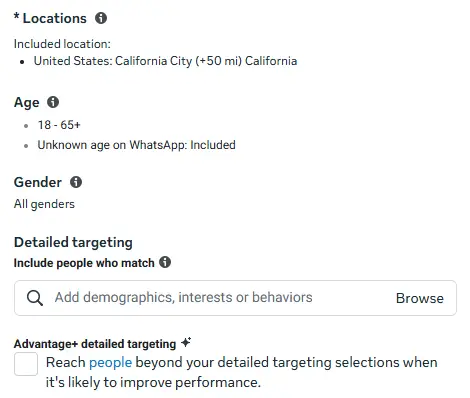
When the Advantage+ Detailed Targeting option is available, Meta displays the following description below the setting:
“Reach people beyond your detailed targeting selections when it’s likely to improve performance.”
What Does the Checkbox Mean?
- Checked / Enabled: Meta can reach people beyond the Detailed Targeting selections you entered when its system predicts that doing so may improve performance.
- Unchecked / Disabled: Meta does not use this specific Detailed Targeting expansion beyond your selected inputs, provided the current campaign setup allows the option to be disabled.
The option is not available in every campaign setup. Some performance-focused setups may automatically apply audience expansion with limited or no ability to turn it off. Therefore, advertisers should not assume that Advantage+ Detailed Targeting can always be manually enabled or disabled.
11. Benefits of Advantage+ Detailed Targeting
Advantage+ Detailed Targeting can:
- Expand audience discovery beyond manually selected targeting inputs
- Give Meta’s delivery system more flexibility to find potential high-performing users
- Reduce the need to manually identify every possible customer segment
- Support campaigns focused primarily on performance outcomes
- Allow Meta’s machine-learning systems to identify opportunities that may not be obvious from manual targeting alone
12. Limitations and Considerations
That flexibility comes with trade-offs.
Advertisers have less manual control over exactly who sees their ads, and selected interests may not strictly determine delivery when audience expansion is active.
Audience composition can therefore become broader than originally intended. This is not necessarily a problem, but advertisers should understand how the feature works before relying on Detailed Targeting as a strict audience boundary.
Running multiple interest-based ad sets can also create audience overlap, particularly when Meta can expand beyond the selected interests.
For this reason, campaign performance should be evaluated using actual results rather than assumptions about who the ad should have reached.
13. When Should You Use Detailed Targeting Inputs?
Detailed Targeting inputs can still be useful when you have genuine customer or market signals worth providing to Meta.
They can be particularly useful when:
- You have clearly relevant interests or audience characteristics
- You are launching a campaign with limited historical performance data
- You are promoting a niche product or service
- Additional audience context may help guide the system
However, adding more interests does not automatically make targeting better. Stacking too many interests into an ad set can make the audience unnecessarily complicated without improving performance.
14. Best Practices
- Choose targeting signals that are genuinely relevant to your product or audience.
- Avoid over-stacking multiple interests simply to make the audience appear more precise.
- Don’t treat selected interests as guaranteed delivery boundaries when Advantage+ expansion is active.
- Limit unnecessary audience fragmentation across ad sets.
- Keep the campaign’s performance goal as the primary focus.
- Give Meta’s delivery system sufficient data to optimize.
- Judge targeting success by actual campaign performance rather than assumptions about audience composition.
- Regularly review the audience controls available in your current Ads Manager setup.
15. Common Misunderstandings
- Selecting an interest does not guarantee delivery only to people associated with that interest. When Advantage+ Detailed Targeting is active, Meta can expand beyond the selected Detailed Targeting inputs.
- Advantage+ Detailed Targeting and Advantage+ Audience are not the same thing. Advantage+ Detailed Targeting focuses specifically on expanding beyond Detailed Targeting inputs, while Advantage+ Audience is a broader audience-automation approach.
- Detailed Targeting is not useless. It can still provide relevant audience context and signals, even when Meta has the ability to expand beyond those inputs.
- Every interest does not need its own ad set. Creating multiple ad sets around individual interests can lead to unnecessary fragmentation and audience overlap.
- Detailed Targeting Expansion is not a separate current setting. Older Meta Ads content may refer to this functionality as Detailed Targeting Expansion or Advantage Detailed Targeting. These are earlier terms associated with Meta’s evolution of audience expansion and should not be treated as separate options that advertisers need to configure.
- Advantage+ Detailed Targeting cannot always be turned off. Whether the setting can be disabled depends on the campaign setup and the controls currently available in Ads Manager.
16. Key Takeaways
Advantage+ Detailed Targeting allows Meta to deliver ads beyond the specific Detailed Targeting selections an advertiser makes when its system predicts that expansion may improve performance.
Detailed Targeting inputs can therefore function as signals rather than strict delivery boundaries when Advantage+ Detailed Targeting is active. Advantage+ Audience represents a broader audience-automation approach that can also use advertiser-provided audience suggestions. The amount of control available depends on the campaign setup, performance goal, and current Ads Manager configuration.
The overall direction of Meta’s audience system is toward providing useful audience signals while allowing its delivery system greater flexibility to find people likely to achieve the desired campaign outcome.