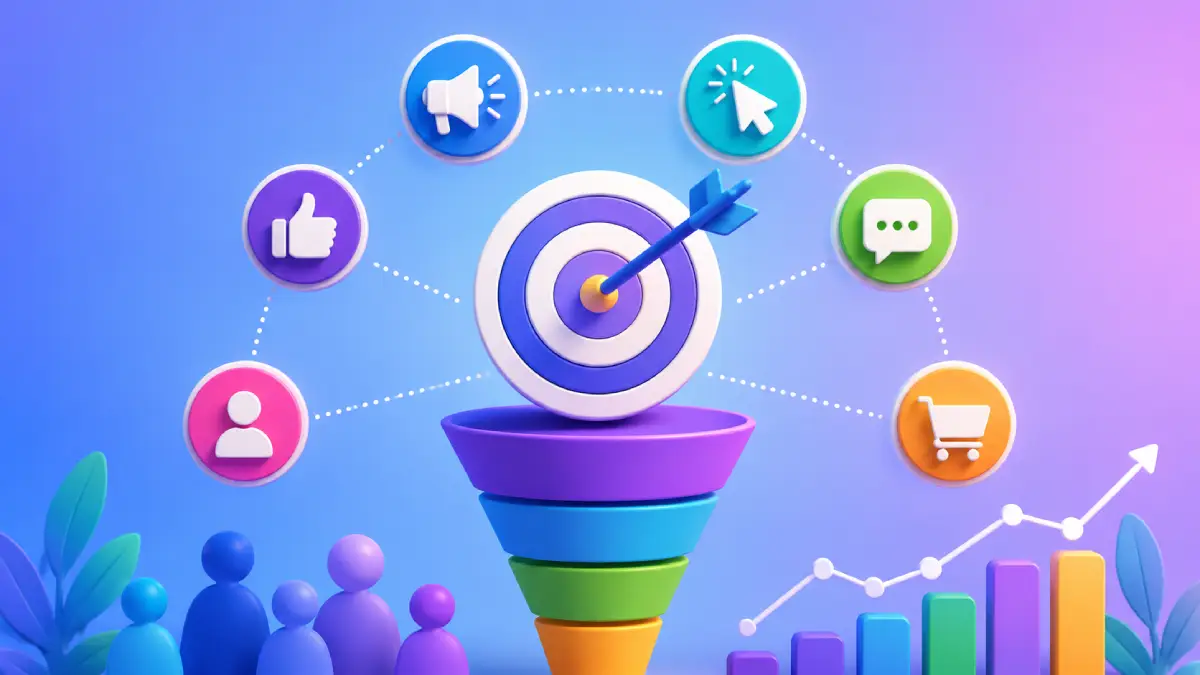
If you’ve ever opened Ads Manager and wondered which campaign objective to choose, you’re not alone. The objective you select is an important part of campaign setup because it tells Meta what outcome you want your advertising to prioritize.
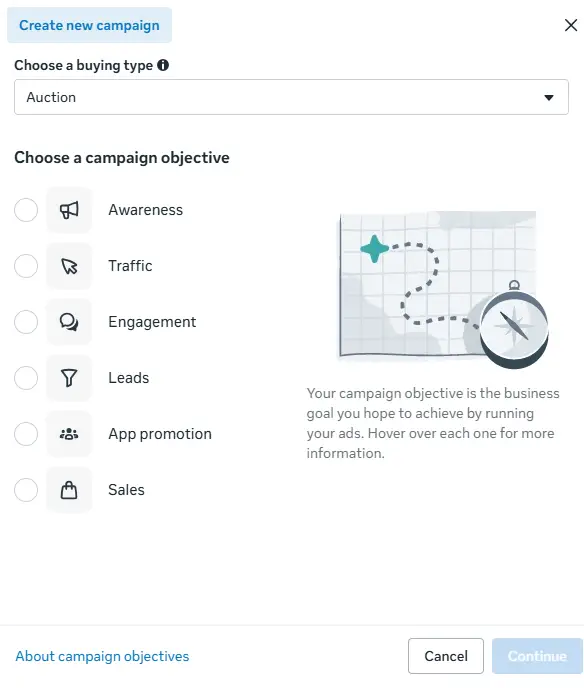
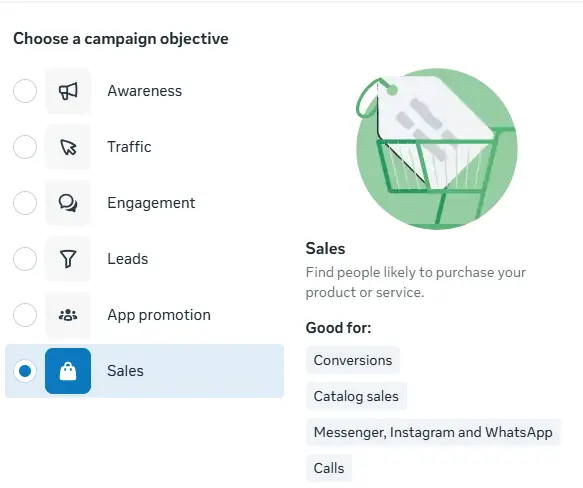
Meta currently offers six campaign objectives: Awareness, Traffic, Engagement, Leads, App promotion, and Sales. Each objective is designed around a different business outcome, and your choice affects the optimization options available when setting up the campaign.
Choosing an objective should therefore start with your primary advertising goal. If you want to increase brand awareness, Awareness may be appropriate. If you want website visits, leads, app growth, or purchases, the corresponding objective is designed to optimize toward that outcome.
In this guide, we’ll break down all six Meta campaign objectives, when to use each one, and how to match them to your actual business goal.
1. What Are Meta Campaign Objectives?
A campaign objective is simply the outcome you tell Meta you want from your ads. Instead of manually configuring dozens of settings, you select one goal such as driving purchases or collecting leads, and Meta’s system uses that information to optimize ad delivery toward the desired outcome.
This structure is based on Meta’s Outcome-Driven Ad Experiences (ODAX) framework, which organizes advertising around six core business outcomes. Your selected objective helps determine the optimization options available when setting up the campaign, so it should match the primary result you want to achieve.
2. How Campaign Objectives Work
When you select a campaign objective, you are telling Meta what result matters most for your campaign. Meta then uses this information, along with your audience, optimization settings, available data, and other signals, to optimize ad delivery toward people who are more likely to take the desired action.
For example, selecting the Traffic objective tells Meta that you want to drive people to a destination such as a website or landing page. The Leads objective is designed to help you generate potential customers through options such as instant forms, website forms, calls, or messaging. The Sales objective focuses on finding people who are more likely to complete purchases or other valuable conversion actions.
Your chosen objective affects the optimization options available to you and how Meta’s delivery system approaches the campaign. This is why selecting an objective that matches your primary business outcome is important.
3. The 6 Types of Meta Campaign Objectives
3.1 Awareness
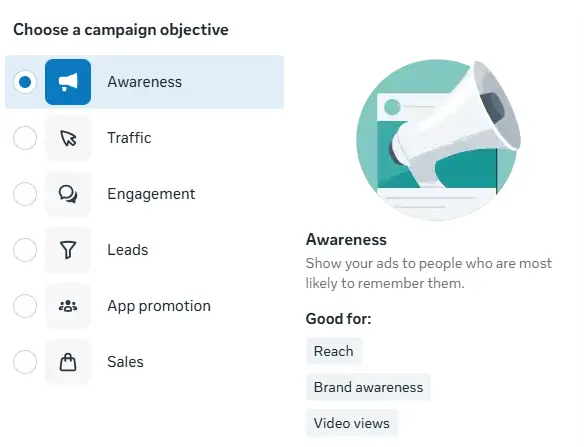
The Awareness objective is designed to increase awareness of your business, brand, product, or service. Meta can optimize delivery toward outcomes such as maximizing reach, impressions, or ad recall, depending on the optimization option available for your campaign.
One useful metric for evaluating Awareness campaigns is Frequency, which shows the average number of times people in the selected audience saw your ad. Depending on the campaign setup and eligibility, Meta may also provide an Ad Recall Lift estimate, depending on campaign eligibility and available measurement options.
Use this objective when your primary goal is to increase awareness, reach, or exposure for your business, product, or service rather than optimize primarily for leads or purchases.
Best for:
- New businesses building brand awareness
- Increasing visibility for an existing brand
- Product or service launches
- Reaching a broad or relevant audience
Example: A skincare startup runs an Awareness campaign to introduce its new product line to people in a target market and build initial brand recognition.
Key Metrics:
- Reach: Number of people who saw your ad.
- Impressions: Total number of times your ad was shown.
- Frequency: Average number of times each person saw your ad.
- CPM: Cost per 1,000 impressions.
- Ad Recall Lift: Estimated increase in the number of people likely to remember seeing your ad, when available.
3.2 Traffic
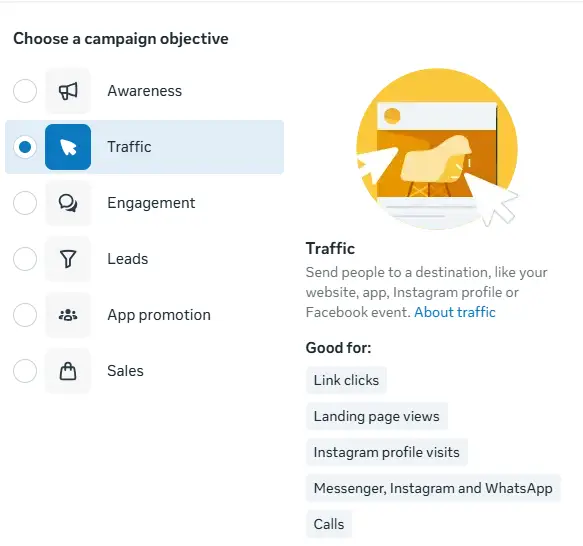
The Traffic objective is designed to send people to a destination such as a website, landing page, app, or other supported destination. Meta can optimize delivery toward people who are more likely to visit the destination based on the optimization option you select.
This objective works well when your primary goal is to get people to visit a destination rather than directly optimize for leads or purchases.
Best for:
- Increasing website visitors
- Promoting blog content
- Sending users to landing pages
- Driving visits to other online destinations
Example: A software company uses a Traffic campaign to send people to a new blog post explaining a common industry problem its product solves.
Key Metrics:
- Link Clicks: Number of clicks on links in your ad.
- CTR (Link): Percentage of impressions that resulted in link clicks.
- Landing Page Views: Number of times people successfully loaded your destination page after clicking.
- CPC (Link): Average cost for each link click.
- Cost per Landing Page View: Average cost for each landing page view.
3.3 Engagement
The Engagement objective is designed to encourage people to interact with your business or content. Depending on the campaign setup, Meta can optimize for outcomes such as post engagement, video views, event responses, or messages.
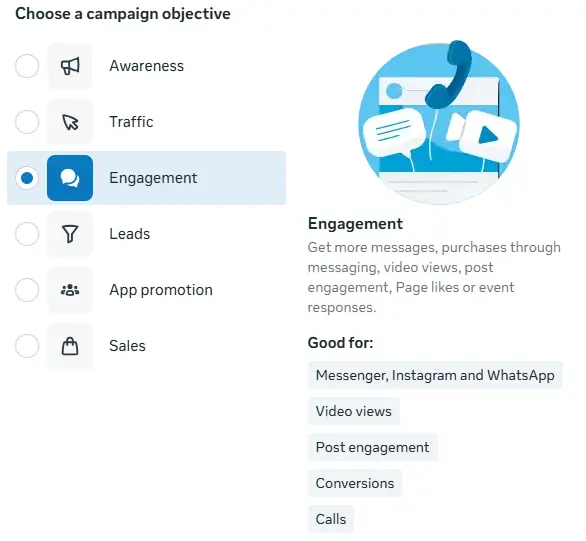
Common engagement outcomes include:
- Likes and reactions
- Comments
- Shares
- Video views
- Messages
- Event responses
This objective is useful when your primary goal is to increase interaction with your content, encourage conversations, or generate engagement around your business.
Example: A local café runs an Engagement campaign to encourage people to interact with a post about its new menu and start conversations with the business.
Key Metrics:
- Post Engagement: Total interactions with your content, such as reactions, comments, and shares.
- Engagement Rate: Percentage of impressions that resulted in an engagement.
- Video Views: Number of times your video met the selected view threshold.
- Cost per Engagement: Average cost for each engagement.
- Messaging Conversations Started: Number of new conversations initiated through your ads, when messaging is the selected outcome.
3.4 Leads
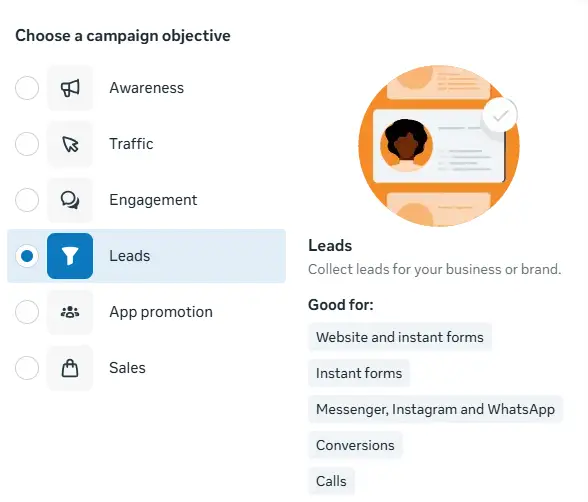
The Leads objective is designed to help businesses generate potential customers and collect information from people interested in their products or services. Depending on the setup, leads can be generated through instant forms, website forms, messaging, or phone calls.
This objective is particularly useful when the desired outcome is an inquiry, registration, consultation request, or other form of customer contact rather than an immediate purchase.
Best for:
- Contact form submissions
- Business inquiries and consultations
- Quote or appointment requests
- Service-based businesses such as real estate, insurance, or coaching
Example: A home renovation company uses a Leads campaign to collect quote requests through an instant form.
Key Metrics:
- Leads: Number of leads generated through the selected lead-generation method.
- Cost per Lead: Average amount spent to generate each lead.
- Lead Conversion Rate: Percentage of people who completed the lead action after reaching the relevant destination.
- Lead Quality: The quality and business value of the leads generated.
- Conversion Rate: Percentage of relevant visitors or prospects who completed the desired lead action.
3.5 App Promotion
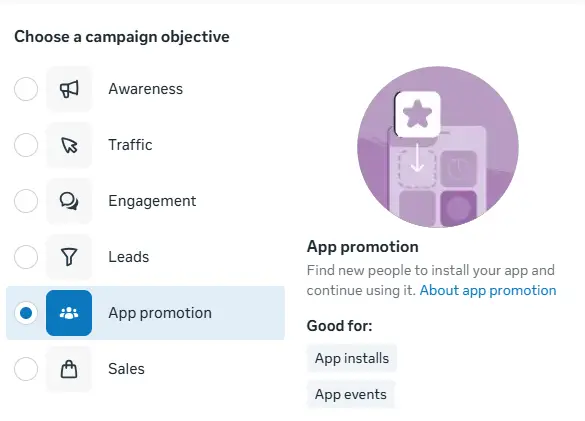
The App promotion objective is designed for businesses that want to promote a mobile app and encourage people to install or use it. Depending on the campaign setup and available optimization options, Meta can optimize delivery for app installs or specific actions people take within the app.
Best for:
- Increasing app installs
- Encouraging app engagement
- Driving valuable actions within an app
- Promoting a new or existing mobile app
Example: A fitness app runs an App promotion campaign to reach people who are likely to install the app and complete key actions after installation.
Key Metrics:
- App Installs: Number of app installations attributed to your ads.
- Cost per Install: Average cost for each app install.
- App Events: Number of selected actions completed within the app.
- Cost per App Event: Average cost for each selected in-app action.
- Purchase Value: Revenue generated from attributed in-app purchases, when applicable.
3.6 Sales
The Sales objective is designed to help businesses drive purchases and other valuable conversion actions. Depending on the setup, Meta can optimize delivery for outcomes such as purchases on a website, in an app, or through other supported sales destinations.
Sales campaigns can be used to reach both new and existing customers. Meta uses available signals, such as website or app activity and conversion data, to help identify people who are more likely to complete the selected action.
Best for:
- Generating online purchases
- Increasing ecommerce sales
- Driving app purchases
- Promoting products through a catalog
- Generating sales from new and existing customers
Example: An online clothing store runs a Sales campaign to promote its products and optimize delivery toward people who are more likely to make a purchase.
Key Metrics:
- Purchases: Number of purchases attributed to your ads.
- Cost per Purchase: Average cost to generate each purchase.
- Purchase Conversion Value: Total value attributed to purchases.
- ROAS (Return on Ad Spend): Revenue attributed to advertising divided by ad spend.
- Purchase Conversion Rate: Percentage of relevant visitors or prospects who completed a purchase.
4. How to Choose the Right Campaign Objective
Start by identifying the primary action you want people to take as a result of your advertising. Choose the campaign objective that most closely matches that outcome.
For example:
Awareness: You want to increase brand awareness or reach.
- Traffic: You want people to visit a website, landing page, app, or other destination.
- Engagement: You want people to interact with your content, respond to an event, or start conversations.
- Leads: You want to generate inquiries, registrations, contact information, or other potential customer actions.
- App promotion: You want to encourage app installs or actions within your app.
- Sales: You want to drive purchases or other valuable conversion actions.
Your audience does not have to be warm or familiar with your brand for you to use a conversion-focused objective. For example, a business can use the Sales objective to reach new customers as well as people who have previously interacted with the brand.
4.1 How Data Affects Conversion Optimization
Meta’s ability to optimize toward conversion outcomes depends partly on the quality and amount of data available. More relevant conversion signals can give the delivery system more information to learn from, but limited data does not mean you cannot use conversion-focused objectives. The objective should still be selected based on the outcome you want to achieve.
4.2 One Business Goal Can Use Multiple Campaign Objectives
A broader business goal does not always map to a single campaign objective. For example, a business focused on increasing sales may use Awareness campaigns to build brand visibility and Sales campaigns to drive purchases. Each campaign has a different immediate outcome, even though both support the same broader business goal.
Tip: See Meta’s official Ad Objectives resource for more information on choosing the right campaign objective.
5. Common Mistakes to Avoid
One common mistake is choosing an objective based on what you eventually want rather than the primary action you want the campaign to optimize for. For example, if your immediate goal is to generate purchases, choosing Traffic simply because it may produce more website visitors does not align the campaign with the final business outcome.
Another mistake is assuming that Sales or Leads objectives should only be used for people who already know your brand. Conversion-focused objectives can be used to reach new audiences as well as people who have previously interacted with your business.
Making frequent changes to a campaign can also make optimization more difficult. Avoid repeatedly changing important campaign settings or judging performance too quickly without allowing enough data to accumulate.
Finally, avoid launching a campaign without a clearly defined goal and success metric. Before creating the campaign, decide what action you want people to take and which metric will determine whether the campaign is achieving that objective.
6. Conclusion
Meta offers six campaign objectives: Awareness, Traffic, Engagement, Leads, App promotion, and Sales. Each objective is designed around a different business outcome, and none is inherently better than the others.
The right objective depends primarily on the result you want your campaign to achieve. Consider the action you want people to take and choose the objective that most closely aligns with that outcome.
Before launching a campaign, clearly define your primary goal and the metric you will use to measure success. Once the desired outcome is clear, selecting the appropriate campaign objective becomes much more straightforward.