Lookalike Audiences remain one of the most talked-about targeting tools inside Meta Ads Manager. If you have ever wondered how Meta finds “more people like your best customers,” this article explains how Lookalike Audiences work, how Meta builds them from source audiences, where they fit into modern campaigns, and how they compare with other audience options.
1. What Are Lookalike Audiences?
A Lookalike Audience is a targeting option inside Meta Ads that helps advertisers reach new people who are similar to an existing source audience. Instead of manually selecting interests or demographic characteristics, advertisers provide Meta with a source audience, such as customers, website visitors, leads, or people who engaged with their content.
Meta’s systems then analyze patterns within that group and identify other users who are predicted to be similar. Because Lookalike Audiences are primarily designed to find new potential customers rather than retarget existing ones, they are commonly used as a prospecting strategy for expanding campaigns beyond current audiences. However, depending on the campaign setup, a Lookalike Audience may function as an audience suggestion rather than a strict delivery boundary.
2. How the Matching Process Works
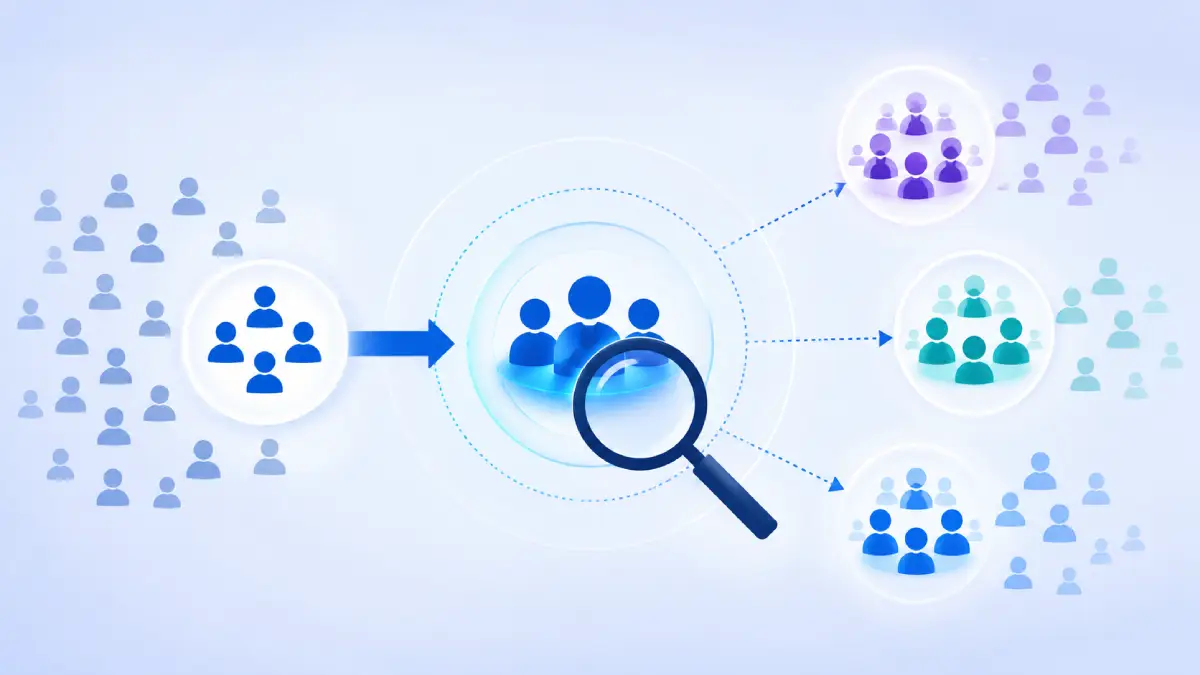
The matching process behind a Lookalike Audience follows a simple three-step flow.
- First, advertisers select a source audience, such as a customer list, website-based audience, or engagement audience.
- Second, Meta analyzes patterns and signals from that source audience to understand common characteristics and behaviors.
- Third, Meta uses those patterns to identify other people who are predicted to be similar to the source audience.
The result is not an identical copy of the original group. Instead, it is a modeled audience based on similarities identified by Meta’s systems.
3. The Role of the Source Audience
Every Lookalike Audience depends on the quality of the source audience used to create it. Meta requires a source audience with at least 100 matched people from the same country to create a Lookalike Audience. Larger and more relevant source audiences can provide Meta with more useful signals for audience modeling.
Many advertisers aim for larger source audiences when possible, but simply increasing the number of people is not enough. The quality and relevance of those people also matter. For example, a source containing recent purchasers may provide stronger signals for a sales campaign than a much larger audience containing everyone who visited a website.
4. Ranking Source Audiences by Strength
Not all source audiences provide the same quality of signals. In general, audiences that represent stronger business outcomes tend to be more valuable for Lookalike creation.
For example:
- Purchasers
- Repeat customers
- High-value customers
- Qualified leads
- People who completed valuable conversions
These audiences can provide stronger intent signals than broader groups such as all website visitors or general content engagement audiences. However, the best-performing source depends on the business model, campaign goal, and quality of the available data. A smaller, highly relevant source can sometimes be more useful than a much larger but less focused audience.
5. Choosing an Audience Size
Lookalike Audiences are commonly created using a percentage size that determines how closely the new audience matches the source audience. A smaller percentage generally represents a smaller group of people with greater similarity to the source, while larger percentages expand reach by including a broader group of users.
For example:
- 1% — smaller audience with closer similarity
- 2%–5% — broader reach with a wider similarity range
- 6%–10% — larger audience designed for greater scale
Advertisers often test different audience sizes because a smaller audience is not always better. The ideal balance depends on the available source data, campaign budget, performance goals, and scaling requirements.
6. Common Types of Lookalike Audiences
Lookalike Audiences can be created from different types of source audiences depending on the data available.
- A customer list Lookalike uses uploaded customer information, such as email addresses or phone numbers.
- A website-based Lookalike uses people who performed actions on a website through connected data sources and events.
- A purchase Lookalike focuses on users who completed transactions, making it useful for finding potential customers similar to existing purchasers.
- A lead Lookalike uses people who submitted lead information as the source.
- Engagement Lookalikes can be created from people who interacted with Facebook Pages, Instagram accounts, videos, or other eligible Meta content.
Advertisers can also create Lookalikes from offline activity data and other eligible first-party data sources. The important factor is not simply the source type but what the people in that source represent for the business.
7. Understanding Value-Based Lookalikes
A value-based Lookalike Audience allows advertisers to provide additional information about the value of their customers instead of treating every customer as identical. By including customer value information, such as purchase value or customer lifetime value, advertisers provide Meta with additional signals about which customers are more valuable.
Meta can then use those signals to identify patterns among higher-value customers and find new people who are more likely to generate similar business results. For example, if a business has many customers but some customers consistently generate much more revenue, a value-based source can help Meta identify similar high-value prospects. This approach is especially useful for businesses where customer value varies significantly.
8. Lookalike vs. Custom Audiences
Custom Audiences and Lookalike Audiences serve different purposes inside Meta Ads.
A Custom Audience is created from people who already have some connection with a business, such as customers, website visitors, app users, or people who engaged with content. Custom Audiences are commonly used for retargeting, exclusions, and creating source audiences.
A Lookalike Audience uses a Custom Audience or another eligible source audience as a reference point to help find new people who share similar characteristics or signals.
In simple terms:
Custom Audience = people who already have a connection with the business
Lookalike Audience = new people modeled from an existing source
9. Lookalike vs. Saved Audiences
Saved Audiences and Lookalike Audiences use different approaches to finding potential customers.
A Saved Audience is manually created using advertiser-selected targeting options such as location, age, gender, interests, and other available targeting controls.
A Lookalike Audience is created from existing audience data, allowing Meta to identify people who are predicted to be similar to that source.
Saved Audiences can be useful when advertisers want to define a particular audience using available targeting options or when limited customer data is available. Lookalikes become more useful when a business has meaningful first-party data that Meta can use as a source for audience modeling.
Both approaches can work alongside Meta’s broader automated audience systems, depending on the campaign and available settings.
10. How Lookalikes Fit Into Advantage+ Audience
Meta’s advertising system has shifted significantly toward AI-powered audience optimization.
With Advantage+ Audience, advertisers can provide audience suggestions and signals, including customer lists and other eligible audience inputs. Meta can then expand beyond those suggestions when its system predicts that broader delivery may improve results.
This means a Lookalike Audience may no longer function as a strict targeting boundary in campaigns using Advantage+ Audience. Instead, it can function as an audience suggestion that helps Meta understand the type of people the advertiser wants to reach.
For example, an advertiser could provide a purchaser-based Lookalike as an audience input. Meta may use the information from that source while also finding additional people outside the selected Lookalike when its system predicts that those people may be valuable.
Therefore, advertisers should not assume that selecting a 1% Lookalike guarantees that ads will only be delivered to people inside that Lookalike. The exact behavior depends on the campaign setup, performance goal, and audience controls available for that campaign.
11. Getting the Most Out of Lookalike Audiences
To get better results from Lookalike Audiences, advertisers should focus on the quality of the source data rather than simply increasing audience size. Starting with valuable customer groups, such as purchasers or high-quality leads, usually provides stronger signals than broad engagement lists.
Testing multiple source audiences and different Lookalike sizes can help identify which combinations perform best. Customer data should also be kept accurate and up to date. Tracking signals such as Meta Pixel and Conversions API should be configured correctly so Meta receives useful information about important customer actions.
Finally, a strong Lookalike Audience cannot compensate for weak creative, poor offers, an ineffective landing page, or inaccurate conversion tracking. Audience quality works together with every other part of the campaign.
12. Mistakes Worth Avoiding
Common Lookalike Audience mistakes usually come from poor data quality or incorrect expectations.
- Creating Lookalikes from weak source audiences: Small, outdated, or low-intent source audiences may provide weaker signals.
- Focusing only on audience size: A large source audience is not necessarily better if it contains many irrelevant users.
- Assuming a smaller percentage is always better: A smaller Lookalike provides closer similarity, but a larger audience may provide more room for delivery and scaling.
- Treating a Lookalike as a strict boundary: In campaigns where Meta can expand beyond audience suggestions, delivery may extend beyond the selected Lookalike.
- Ignoring conversion quality: Poor or incomplete conversion signals can reduce the usefulness of audience modeling.
- Creating too many similar Lookalikes: Testing can be useful, but audiences should have a clear purpose instead of being created without a strategy.
13. When Lookalikes Make Sense
Lookalike Audiences are most useful when a business already has meaningful first-party data and wants to expand beyond its existing customers.
They are commonly used when:
- Scaling successful acquisition campaigns
- Finding new potential customers
- Finding people similar to purchasers
- Finding prospects similar to qualified leads
- Expanding from high-value customers
- Entering new markets with relevant source data
Businesses with limited or low-quality data may need to start with broader targeting approaches until enough meaningful audience signals become available. Lookalikes should therefore be viewed as one audience signal within a broader campaign strategy rather than as a guaranteed shortcut to better performance.
14. Final Thoughts
Lookalike Audiences remain an important part of Meta Ads because they allow advertisers to turn existing audience data into opportunities for reaching new potential customers. The basic concept is simple: provide Meta with a relevant source audience, and Meta uses its systems to find people who are predicted to be similar. However, the role of Lookalikes has changed as Meta has moved toward AI-powered audience delivery.
In campaigns using Advantage+ Audience and other automated targeting systems, Lookalikes can function as audience suggestions rather than strict targeting boundaries. The strongest results still come from combining high-quality first-party data, accurate tracking, strong creative, a relevant offer, and a clear campaign strategy.