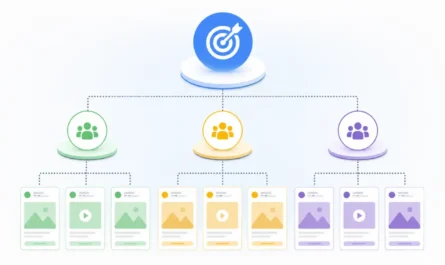

Picking the right audience is one of the most important decisions you make when setting up Meta Ads. Every campaign usually targets a different group of people based on what stage of the buying journey they’re in or what action you want them to take. But here’s something a lot of advertisers don’t think about until their costs start climbing: the same person can easily end up sitting inside more than one of your audiences at the same time. This situation is called audience overlap, and understanding it can save you money and confusion in your account.
1. What Is Audience Overlap in Meta Ads?
In simple terms, audience overlap happens when two or more of your audiences contain the same people. A single Facebook or Instagram user isn’t locked into just one bucket—they can exist across several audience types you’ve built.
For example, one person could show up in your Website Visitors custom audience, your Instagram Engagers custom audience, and a Customer Lookalike audience all at once. That same individual belongs to multiple groups simultaneously, even though you created each audience for a different purpose.
2. How Audience Overlap Happens
2.1 Overlap Between Saved Audiences
Interest-based audiences often blend together more than advertisers expect. If you build separate saved audiences around online shopping, fashion shopping, and a specific clothing brand, many of the same users will likely appear in all three, since these interests naturally attract similar people.
2.2 Overlap Between Custom Audiences
Warm audiences frequently overlap too. Someone might visit your website, follow your Facebook Page, engage with your Instagram profile, and appear on your customer list—all as the same person. A single customer often interacts with a brand through several channels, which means they can land in multiple custom audiences without you intending it.
2.3 Overlap Between Lookalike Audiences
Lookalike audiences are built to find new people who resemble your best customers, so it’s common for different lookalikes to share users. A Customer Lookalike audience and a Purchase Lookalike audience, for instance, are both modeled on valuable customers, so naturally some of the same users get pulled into both.
2.4 Overlap Between Campaign Audiences
Even separate campaigns can end up reaching the same crowd. A broad Sales campaign and an interest-based Sales campaign might look different on paper, but both can still reach some of the same people.
2.5 Example of Audience Overlap
Imagine you are selling fitness products.
You create:
Audience A:
People interested in fitness.
Audience B:
Website visitors from the last 30 days.
Audience C:
People who engaged with your Instagram page.
A person who follows fitness content, visits your website, and interacts with your Instagram posts can exist in all three audiences.
This means your campaigns may reach the same person multiple times.
3. Why Audience Overlap Matters
3.1 Your Campaigns May Compete With Each Other
When multiple ad sets you own target similar people, they can enter the same ad auction against one another. Instead of reaching more unique people, your campaigns may compete for delivery among the same group of users.
3.2 Budget May Not Be Used Efficiently
Splitting your spend across several similar audiences can dilute your results. A single, larger audience can sometimes perform better than several smaller, overlapping audiences because Meta’s delivery system has more data and flexibility to optimize delivery.
3.3 Users May See Similar Ads Multiple Times
Overlap tends to increase how often the same person sees your ads, which can lead to ad fatigue faster than you’d expect.
3.4 Reporting Becomes More Difficult
Once several campaigns are quietly reaching the same people, it becomes much harder to tell which audience actually deserves credit for a conversion.
4. How to Check Audience Overlap in Meta Ads
4.1 Review Your Audience Setup
Start by looking through your saved, custom, and lookalike audiences to spot ones that seem to be targeting similar groups.
4.2 Use Meta’s Audience Comparison Tools
Meta provides audience comparison tools that allow advertisers to analyze whether different audiences share users. The availability and location of these tools can vary depending on account type and interface updates. These tools help compare audiences and estimate how many users are shared between them. Keep in mind that audience comparison may require audiences to meet certain size requirements.
4.3 Review Campaign Structure
Check whether different campaigns are targeting the same location, similar interests, or comparable customer groups, since structural overlap is just as common as audience-level overlap.
5. How to Reduce Audience Overlap
5.1 Create Clear Audience Segments
Give every audience a distinct role—cold audiences for new prospects, warm audiences for people who’ve already interacted with your brand, and hot audiences for those closest to purchasing.
5.2 Avoid Creating Too Many Similar Audiences
Building a separate audience for every small interest variation usually backfires, since it just multiplies the overlap you already have.
5.3 Use Audience Exclusions
- Exclude existing customers from campaigns meant for new customer acquisition.
- Exclude website visitors from cold prospecting campaigns when you’re running a dedicated retargeting effort.
5.4 Combine Similar Audiences When Needed
If two audiences serve the same purpose, merging them can actually help Meta gather more data and optimize delivery better than keeping them apart.
6. Audience Overlap in Advantage+ Audience Campaigns
Meta has shifted heavily toward AI-driven audience delivery, where its system uses these signals to find people who are more likely to take the desired action. Instead of manually defining every targeting parameter, advertisers give Meta’s system a few suggestions—like a custom audience or set of interests—and the algorithm searches for people most likely to convert.
Because of this shift, the old habit of building dozens of narrow audience segments matters less. The better question isn’t “how many audiences should I create,” but rather “does each audience I’ve built actually serve a different purpose.”
7. Audience Overlap vs Audience Fragmentation
Audience fragmentation is the opposite problem—it happens when you split your targeting into so many small audiences that none of them collect enough data to perform well. Rather than running ten nearly identical interest audiences, it’s often smarter to use one broader audience paired with strong creative and reliable conversion signals.
The goal is finding a middle ground: avoid excessive overlap where campaigns compete for the same people, but also avoid fragmenting your audiences into pieces too small to give Meta’s algorithm anything useful to learn from.
8. Does Audience Overlap Always Mean a Problem?
Not necessarily. Some overlap is completely normal—retargeting campaigns, different stages of your funnel, and separate product lines will naturally reach some of the same people. The impact depends on factors like campaign objective, budget, audience size, and campaign structure.
The real issue arises when nearly identical campaigns or ad sets with the same goal are targeting a very similar audience, since that’s when internal competition starts hurting performance rather than helping it.
9. Common Audience Overlap Mistakes
- Building too many nearly identical interest audiences.
- Running several campaigns that all reach the same users.
- Forgetting to exclude existing customers from acquisition-focused campaigns.
- Splitting audiences apart without a real strategic reason.
- Focusing purely on targeting settings while neglecting creative quality, which increasingly plays a bigger role in how Meta’s delivery system finds the right people.
10. Best Practices for Managing Audience Overlap
- Give every audience a clear, defined purpose.
- Keep your campaign structure as simple as possible.
- Resist the urge to split audiences unnecessarily.
- Apply exclusions where they genuinely add value.
- Check performance regularly to catch overlap before it becomes costly.
- Let Meta’s AI-driven tools handle broader targeting decisions when it makes sense to do so.
Audience overlap is simply a natural part of running multiple Meta Ads campaigns since different audiences will inevitably contain some of the same people. The real objective isn’t to chase zero overlap—it’s to avoid the kind of unnecessary competition and confusion that drains your budget. A clean, well-organized audience structure, combined with strong creative and accurate conversion tracking, tends to deliver far better results than obsessing over every percentage point of shared reach.