
Meta Ads are paid advertisements that businesses use to reach potential customers across Meta’s platforms and available partner inventory. Depending on the campaign setup and eligible placements, ads can appear across Facebook, Instagram, Messenger and Meta Audience Network. Meta Ads give advertisers tools to define campaign objectives, provide audience and delivery inputs, manage advertising spend, choose or automate placements, create different ad experiences, and measure performance. Meta’s advertising system then uses these inputs, along with machine learning and auction-based delivery, to determine which eligible ads to show and when.
This beginner’s guide explains the fundamentals of Meta Ads, including how Meta’s advertising system works, the business ecosystem, campaign structure, objectives, audience targeting, placements, budgets, measurement and automation.
1. What Are Meta Ads?
Meta Ads are an auction-based advertising system that allows businesses to promote products, services, apps, content and other business outcomes to people across Meta’s advertising inventory. When an advertiser creates a campaign, Meta considers the campaign objective, audience inputs, budget, creative, placement eligibility and optimization settings. Its delivery system then uses these inputs and machine learning to determine which eligible ad opportunities are most likely to produce the desired result.
Ads are not simply shown to everyone who matches an advertiser’s targeting settings. For each available ad opportunity, Meta’s auction evaluates eligible ads based on factors such as the advertiser’s bid or cost controls, estimated action rate and ad quality. The system uses these signals to determine which ad is delivered.
This makes Meta Ads more than a simple audience-targeting tool. Advertisers provide the business goal and campaign inputs, while Meta’s automated systems increasingly influence who receives the ad, where it is delivered and how the available budget is allocated.
2. How Meta Ads Work
Meta Ads work through a combination of advertiser settings, machine learning and an ad auction. When an advertising opportunity becomes available, Meta evaluates eligible ads and estimates which ad is most likely to create value for the person and advertiser.
The process broadly works like this:
- Campaign objective: The advertiser selects a business objective that tells Meta what type of result the campaign is intended to achieve.
- Audience and delivery settings: The advertiser provides audience information, controls and suggestions where available.
- Budget and bidding: The advertiser determines how much to spend and, depending on the campaign setup, can use different bidding or cost-control options.
- Creative: The advertiser provides the images, videos, text and other creative assets.
- Ad auction: When an opportunity to show an ad occurs, Meta evaluates eligible ads using factors such as the advertiser’s bid, estimated action rate and ad quality.
- Delivery optimization: As the campaign receives data, Meta’s systems use signals from people’s interactions and conversions to improve delivery toward the selected optimization goal.
The auction therefore does not simply reward the advertiser willing to pay the most. Meta considers the expected value of each eligible ad when determining which ad to deliver.
3. Benefits of Advertising on Meta
Meta Ads provide businesses with a flexible way to reach potential customers, promote products or services, generate leads and drive conversions. Key benefits include:
- Broad Reach: Businesses can advertise across eligible Meta platforms and placements, giving them access to large and diverse audiences.
- Flexible Campaign Goals: Meta supports campaigns designed for different business outcomes, from building awareness and generating engagement to driving leads, app activity and sales.
- Audience Flexibility: Advertisers can use available audience controls, audience inputs and first-party data sources to guide delivery toward relevant people.
- Budget Control: Advertisers can set and manage spending according to their campaign and business requirements.
- Performance Measurement: Meta provides reporting and performance metrics that help advertisers understand how campaigns are performing.
- Automation: Meta can automate parts of campaign setup and delivery, reducing the need for advertisers to manually manage every decision.
- Creative Flexibility: Businesses can use different ad formats and creative experiences to present their products, services or messages.
- Retargeting: Eligible Custom Audiences and other first-party data sources can help businesses reconnect with people who have previously interacted with their business.
4. Meta Ads vs. Organic Content
Meta Ads use paid distribution to reach people based on campaign objectives, audience signals, budget and delivery settings. Organic content is published without paying for advertising distribution and is primarily distributed through Meta’s content-ranking systems.
The key difference is control and distribution. Meta Ads give businesses greater control over advertising objectives, audience inputs, spending and measurement, while organic content depends more on how Meta’s systems rank and distribute content to users.
Businesses can use both approaches together: organic content can help build a presence and engage an audience, while Meta Ads can provide additional reach and support specific business outcomes such as traffic, leads or sales.
5. Meta Ads Ecosystem Explained
A typical Meta advertising setup can include several connected components:
- Personal Facebook account: A real personal account can be used to access Meta’s business and advertising tools. It should represent a real person rather than a shared or fabricated identity.
- Facebook Page or Instagram professional account: Depending on the campaign and ad identity, businesses can use a Facebook Page, an Instagram professional account, or both.
- Meta Business Portfolio: A central business container used to organize business assets, access permissions and people who manage them. It is especially useful for businesses, teams and agencies managing multiple assets.
- Meta Business Suite: A centralized interface for managing connected Facebook and Instagram business activities, including content, messaging, notifications, insights and other business tools. It can also provide access to advertising and business management features.
- Ad Account: The account where campaigns, billing and advertising activity are managed.
- Meta Ads Manager: The primary interface used to create, manage, monitor and analyze Meta advertising campaigns.
- Payment Method: A valid payment method or other applicable billing arrangement is required for an account to run paid advertising.
- Business Assets and Data Sources: Depending on the campaign, businesses may also use assets such as websites, datasets, catalogs, apps, WhatsApp assets and other connected data sources.
Note: For official information about Meta’s advertising tools, business assets, and advertising features, visit the Meta for Business website and Meta Business Help Center.
6. Ad Account
An ad account is the account where Meta advertising campaigns are created, managed, measured and billed.
Ad accounts can be associated with a person’s Meta account or organized within a Meta Business Portfolio. For businesses, agencies and teams, keeping advertising assets organized within the appropriate business structure generally provides better control over access, ownership and administration.
The important distinction for beginners is not simply “personal versus business” ad account. Instead, understand:
- Who owns the ad account
- Which Meta Business Portfolio manages it
- Which Page and Instagram account are connected
- Who has permission to access it
- Which payment method and billing settings are attached to it
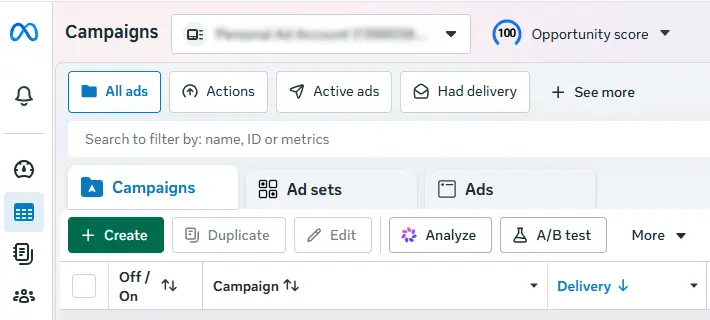
7. Meta Ads Campaign Structure
Meta Ads use a three-level campaign structure:
- Campaign: Defines the campaign objective and certain campaign-level settings.
- Ad Set: Defines important delivery settings such as audience, placements, schedule and, depending on the campaign configuration, budget and optimization settings.
- Ad: Contains the creative that people see, including the media, primary text, headline, call to action and other applicable elements.
This structure allows advertisers to organize the campaign objective at the campaign level, configure important delivery settings at the ad set level where applicable, and create different creative variations at the ad level.
8. Meta Ads Campaign Objectives
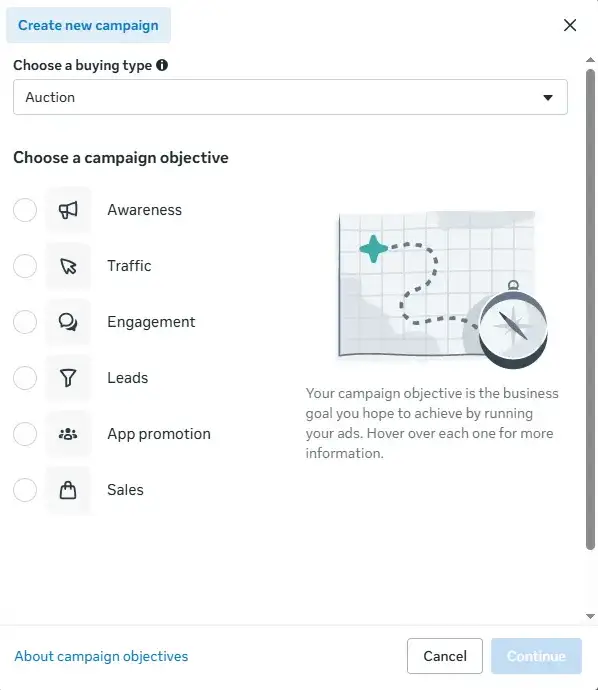
Meta currently organizes advertising around six core campaign objectives:
- Awareness: Build awareness and reach people who are more likely to remember or engage with the brand.
- Traffic: Send people to a destination such as a website, app, landing page or other supported destination.
- Engagement: Find people who are more likely to take supported engagement actions, such as interacting with content, watching videos or starting conversations.
- Leads: Generate leads through forms, messaging, calls or other supported lead-generation experiences.
- App Promotion: Promote an app and drive installs or other valuable app actions.
- Sales: Find people who are more likely to purchase or complete other valuable conversion actions.
The selected objective influences the optimization options and the types of people Meta’s delivery system is designed to find.
9. Meta Ads Audience Targeting
Meta provides several ways to define or guide the audience for an ad campaign:
- Audience controls: Settings such as location, minimum age and language can act as controls where available.
- Detailed targeting: Interests, demographics and other available targeting options can be used as audience inputs or suggestions depending on the campaign setup.
- Custom Audiences: Reach people based on interactions or data sources connected to your business, subject to eligibility and privacy requirements.
- Lookalike Audiences: Help identify people who resemble a source audience when the feature is available for the campaign setup.
- Advantage+ audience: Uses audience suggestions and Meta’s AI systems to search more broadly for people who are likely to produce the desired result.
Modern Meta targeting therefore combines advertiser-provided audience inputs with automated delivery, allowing Meta to determine which eligible people are most likely to produce the desired result.
10. Meta Ads Placements and Formats
Meta can deliver ads across eligible placements on Facebook, Instagram, Messenger and Meta Audience Network, depending on the campaign, objective, creative and other settings.
- Advantage+ placements: Let Meta automatically select eligible placements and distribute delivery across available opportunities based on the campaign’s optimization goal.
- Manual placements: Allow advertisers to select specific eligible placements when they have a particular reason to control where ads appear.
- Creative formats: Depending on the campaign setup, advertisers may use formats such as image, video, carousel and collection, along with specialized ad experiences for objectives such as lead generation.
The available placements and creative options can vary by objective, destination, account and campaign configuration.
11. Meta Ads Budgets and Budget Optimization
Meta provides several ways to manage advertising spend:
- Daily budget: Sets an average amount you intend to spend per day for the applicable campaign or ad set.
- Lifetime budget: Sets the total amount you intend to spend over the scheduled duration.
- Account spending limit: Sets an account-level spending ceiling that can restrict total advertising spend.
- Advantage+ campaign budget: Allows you to set a campaign-level budget and lets Meta distribute that budget across eligible ad sets in real time based on opportunities to achieve the campaign’s optimization goal.
Budget behavior can vary according to the campaign setup, budget type, bidding strategy and other delivery settings.
12. Advantage+ and Automation
Advantage+ is Meta’s family of AI-powered automation features that can automate parts of campaign setup and delivery. Depending on the campaign, Advantage+ features can influence areas such as:
- Audience selection and expansion
- Placements
- Campaign budget distribution
- Creative optimization
- Other delivery decisions
Advantage+ features are designed to give Meta more flexibility to automate decisions within the areas covered by the feature. Depending on the campaign setup, advertisers may still provide controls, suggestions or other inputs that guide how the system operates.
The key concept is that Advantage+ reduces the need for advertisers to manually configure every part of campaign delivery. Instead, Meta can automate eligible decisions using the information, controls and creative inputs provided by the advertiser.
13. Key Metrics to Know
Some fundamental Meta Ads metrics include:
- Impressions: The number of times ads were shown.
- Reach: The number of people who saw the ads.
- Frequency: The average number of times each person was reached.
- CPM: The average cost per 1,000 impressions.
- Cost per Result: The average amount spent to generate the result selected for the campaign.
- CPC: Cost per click, calculated according to the click metric being reported.
- CTR: Click-through rate, showing the percentage of impressions that resulted in the reported click action.
- ROAS: Return on ad spend, comparing attributed revenue with advertising spend.
The most important metrics depend on the campaign objective and optimization goal. A Sales campaign, for example, should not be judged only by clicks or CTR when the primary business outcome is purchases or revenue.
14. Conclusion
Meta Ads provide businesses with a flexible advertising system for reaching potential customers, generating demand, driving conversions and measuring advertising performance across Meta’s platforms. Understanding these fundamentals helps advertisers see how Meta’s business ecosystem, campaign structure, objectives, audiences, budgets, placements, creative and measurement work together.
Modern Meta advertising relies heavily on automation and machine learning. Successful advertisers therefore need to understand both the settings they control and the automated systems that influence campaign delivery. Once these fundamentals are clear, the next step is to study audience building, campaign creation, creative strategy, retargeting, measurement, reporting and optimization in greater depth.