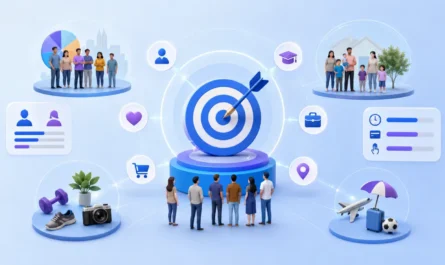

Audience targeting is one of the most important parts of every Meta Ads campaign because it helps businesses reach people who are more likely to be interested in their products or services. This module explains how audience targeting works, why understanding your customers matters, and how Meta’s AI-powered systems have changed the way advertisers approach targeting today. While traditional targeting methods are still important, Meta has increasingly moved toward automation, where audience inputs often guide the system rather than completely control delivery.
1. Why Audience Targeting Still Matters
Audience targeting is simply the practice of showing ads to the people most likely to care about them. Meta uses a wide range of signals, including user interactions, engagement patterns, advertiser-provided information, and conversion data, to predict which people are more likely to complete the desired action. Effective audience targeting can improve ad relevance, help control costs, and increase the chances of achieving campaign goals. Skipping it, or doing it carelessly, means wasted spend on people who were never going to buy.
That said, the mechanics of “how Meta matches ads to people” have changed substantially. Where advertisers once hand-picked interests and behaviors, Meta’s algorithm now treats most manual inputs as suggestions rather than strict rules, leaning instead on machine learning to decide who actually sees an ad.
2. Audience Fundamentals
A target audience is the group of people a business wants to reach, usually defined by shared traits like age, location, interests, or buying habits. Segmentation breaks a broader market into smaller groups so messaging can be tailored more precisely. When done correctly, segmentation can improve relevance, help advertisers create better creatives, and make campaign optimization more effective. However, results depend on factors such as industry, budget, creative quality, offer, and conversion data.
Advertisers can choose between broader audiences with fewer restrictions and more specific audiences with additional targeting signals. The right approach depends on factors such as campaign objective, available data, market size, and advertising goals. A few practical considerations worth keeping in mind when sizing an audience:
- For interest-based targeting, advertisers should generally avoid making audiences unnecessarily small. A sufficiently large audience gives Meta’s delivery system more opportunities to find people who are likely to take the desired action. The ideal audience size depends on factors such as location, industry, budget, campaign objective, and available conversion data.
- Broad targeting can work effectively when an account has strong conversion signals and enough data for Meta’s algorithm to optimize. However, smaller advertisers can also benefit from broader audiences depending on their objective, market size, and available data.
- Custom Audiences must meet Meta’s minimum size requirements before they can be used for targeting. Larger audiences generally provide more opportunities for delivery and optimization, while very small audiences may experience limited reach or higher costs.
Common mistakes include shrinking an audience so much that delivery stalls, and stacking so many interest filters that good customers get filtered out by accident. A newer mistake worth flagging: Meta restricts the use of certain sensitive information for advertising purposes. Advertisers cannot create audiences based on sensitive personal attributes, and audience strategies must follow Meta’s advertising policies.
3. Creating a Buyer Persona
A buyer persona is a semi-fictional profile representing an ideal customer, built from real data about demographics, goals, pain points, and buying behavior. Personas matter because they keep messaging grounded in a real person’s motivations instead of vague assumptions about “everyone.”
Key elements typically include:
- Age range, occupation, or business role
- Core challenges or frustrations
- Preferred platforms, content preferences, and buying habits
- Common objections to purchasing
Building one well means combining customer interviews, support tickets, and website analytics rather than guessing. A common mistake is creating a persona once and never updating it, even as the actual customer base evolves.
4. Mapping the Customer Journey
The customer journey describes the path someone takes from first hearing about a brand to becoming a repeat buyer. It is commonly divided into stages such as awareness, consideration, conversion, and retention. Different businesses may define these stages differently depending on their sales process.
At each stage, intent looks different. Someone in the awareness stage may be discovering a problem, need, or opportunity for the first time, while someone in the decision stage is comparing specific options before buying. Ads should match that intent: educational or entertaining content works early, while comparison-driven or offer-driven content works later. A frequent misstep is showing a hard sales pitch to a cold audience that has never heard of the brand, which usually just burns budget.
5. Cold, Warm, and Hot Audiences
- Cold audiences have no prior relationship with the brand and need to be introduced to it.
- Warm audiences have shown some level of interest or interaction with a business, such as engaging with content, visiting a website, watching videos, or interacting with social profiles.
- Hot audiences are people who show strong purchase intent, such as adding products to cart, starting checkout, requesting information, or showing clear interest in completing a purchase.
Choosing the right type depends on the campaign goal. Cold audiences suit brand awareness campaigns, warm audiences suit consideration content, and hot audiences suit direct-response offers. A common mistake is running the same creative across all three, which ignores how differently each group is likely to respond.
6. Core Targeting Options
Core targeting refers to the foundational filters available in Ads Manager, including location, age, gender, language, demographics, interests, and behaviors. These options are still available, but their role has changed as Meta’s AI-powered delivery systems have become more advanced. Many audience inputs now work as signals that help guide delivery rather than strict limitations, allowing Meta’s system to find people who are more likely to complete the desired action. However, available controls depend on the campaign type, account setup, and Meta’s current advertising features.
7. Detailed Targeting in Practice
Detailed targeting layers interests, behaviors, and demographic filters on top of core targeting. It can also involve refining audiences through available targeting controls and audience restrictions depending on the campaign setup.
Detailed targeting can still be useful, especially when advertisers need to provide additional audience signals, reach a niche market, or test specific customer groups. Its effectiveness depends on the campaign objective, audience size, creative quality, and available conversion data.
8. Doing Real Audience Research
Audience research means gathering evidence about who customers actually are, rather than relying on assumptions. This includes reviewing customer support conversations, analyzing website and pixel data, running surveys, and studying competitor audiences.
Finding pain points and interests through this process feeds directly into stronger personas and better creative angles. The goal is to turn scattered observations into audience insights that can be tested in live campaigns, since research that never reaches an ad set doesn’t do much good.
9. Understanding Advantage+ Audience
Advantage+ Audience is Meta’s AI-powered audience solution that helps advertisers reach people who are more likely to take the desired action. It is available across several campaign objectives, including Sales, Leads, and App Promotion. Instead of advertisers dictating exact rules, Advantage+ treats inputs like age, gender, and detailed targeting as soft suggestions that guide the algorithm without limiting it strictly. Certain controls, such as location, minimum age, and Special Ad Category requirements, may continue to act as restrictions depending on the campaign setup, while other audience inputs can guide Meta’s delivery system.
Meta has reported improvements from using Advantage+ Audience and other AI-powered solutions in certain situations. However, performance varies based on factors such as campaign objective, creative quality, offer, budget, audience signals, and conversion data.
The trade-off is control. Advertisers used to fine-tuning every filter may find Advantage+ feels like giving up the steering wheel, and it’s fair to treat that adjustment period as a real limitation rather than pretending it doesn’t exist.
10. How Audience Targeting Works With Meta Ads Campaigns
- Campaign objective defines the desired outcome
- Audience targeting helps Meta find relevant people
- Creative communicates the message
- Conversion data helps Meta improve delivery
- Testing helps identify better-performing audiences
11. Bringing It Together
Audience targeting has evolved from relying heavily on manual audience selections to a more balanced approach that combines advertiser insights with Meta’s AI-powered optimization. Understanding customers, creating relevant signals, and providing quality conversion data are now essential for getting better results from Meta Ads.
Successful audience targeting is no longer only about finding a perfect audience manually; it is about combining customer understanding, strong creative, accurate data signals, and Meta’s optimization technology.