
What Is Google Ads? For businesses trying to get noticed online, this is one of the first questions worth answering. Google Ads is Google’s paid online advertising platform, giving businesses a way to put their products, services, or apps in front of potential customers at the right moment. Unlike organic visibility, which takes time to build, Google Ads offers a more immediate route to reaching an audience already using Google’s various platforms. Over the years, it has grown far beyond simple search-based ads, now covering formats like video, shopping, and app promotion, making it a versatile tool within any digital marketing strategy.
1. What Is Google Ads?
Google Ads is Google’s advertising platform, used by businesses and advertisers to promote products, services, apps, websites, and other offers to people who may be interested in them. Rather than being a single advertising format, Google Ads provides access to multiple campaign types, advertising surfaces, and formats through one platform.
Ads served through Google Ads can reach people based on factors such as what they search for, their location, audience characteristics, context, and other eligible campaign settings. Advertisers configure campaign goals, budgets, targeting, and other settings, while Google’s advertising systems determine which eligible ads can participate in relevant advertising opportunities.
It’s important to understand what Google Ads is not:
- It is not Google’s organic search results, which are unpaid listings determined by Google’s organic ranking systems.
- It is not SEO (Search Engine Optimization), which focuses on improving a website’s organic visibility.
- It is not Google Business Profile, which helps businesses manage their business information and presence on Google.
- It is not Google AdSense, which is a separate publisher-side advertising product that allows website owners to display ads and earn revenue.
2. How Does Google Ads Work?
At a high level, Google Ads follows a straightforward process:
- An advertiser creates an advertising campaign within the Google Ads platform.
- The advertiser selects an appropriate campaign objective and configures relevant settings.
- Targeting and other eligibility conditions determine which advertising opportunities may be relevant.
- When an advertising opportunity occurs, eligible ads can participate in Google’s advertising auction and related systems.
- Google determines which eligible ads may be shown and where they may appear.
- Advertisers are charged according to the applicable campaign and billing model.
- Advertisers can measure results and manage their campaigns based on performance.
This process allows businesses to reach potential customers at relevant moments while Google’s advertising systems determine which ads are eligible to serve.
The exact process varies depending on the campaign type, advertising surface, settings, and other factors.
3. Where Can Google Ads Appear?
One of the most important things to understand about Google Ads is that it extends far beyond Google Search.
Depending on the campaign type and settings selected, ads can appear across several Google surfaces, including:
- Google Search for people searching for relevant products, services, or information.
- YouTube for video and other eligible advertising formats.
- Google Display Network and eligible websites and apps.
- Google Shopping for product-focused advertising.
- Google Maps and other eligible Google surfaces.
- Additional advertising inventory available through specific campaign types.
The exact placements available to an advertiser depend on the campaign type, settings, eligibility requirements, and Google’s advertising systems.
This broader reach is one reason the platform is called Google Ads rather than Google AdWords. It reflects the expansion of Google’s advertising platform beyond traditional search advertising.
4. Main Google Ads Campaign Types
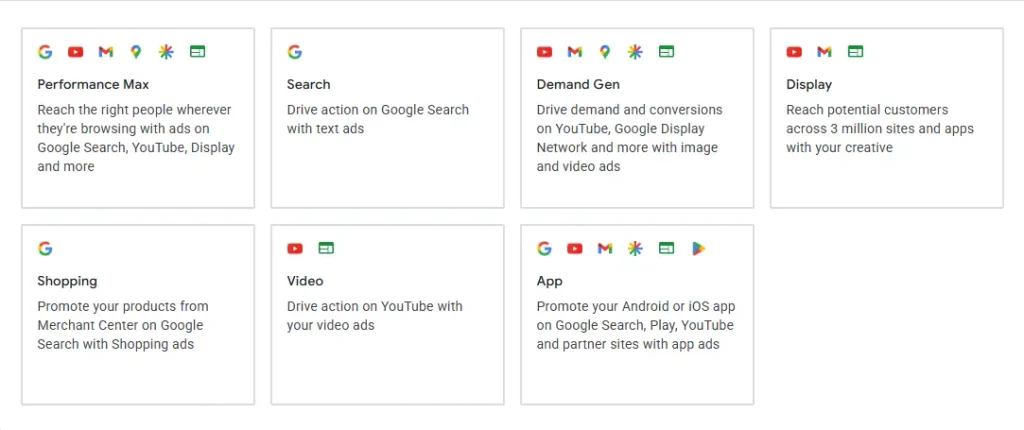
Google Ads offers several campaign types designed for different advertising goals and channels.
4.1 Search Campaigns
Search campaigns allow businesses to show ads to people who are searching for relevant products, services, or information on Google.
They are particularly useful for reaching people who already have an identifiable search need or intent.
4.2 Performance Max
Performance Max is a goal-based campaign type designed to give advertisers access to multiple Google advertising channels from a single campaign.
It uses Google’s AI systems to help optimize campaign delivery based on the advertiser’s goals.
4.3 Shopping Campaigns
Shopping campaigns help businesses promote products by presenting product information, such as images, names, and prices, to potential shoppers through eligible shopping advertising placements.
4.4 Video Campaigns
Video campaigns support video advertising, primarily across YouTube and other eligible video inventory.
4.5 App Campaigns
App campaigns are designed to help businesses promote mobile applications and encourage actions such as app installs or in-app activity.
4.5 Demand Gen Campaigns
Demand Gen campaigns are designed to help advertisers reach potential customers through visually engaging advertising formats across eligible Google surfaces.
Google Ads campaign types, features, and available advertising options can evolve as Google updates the platform.
5. How Google Ads Has Evolved
Google Ads has developed significantly since its original launch, expanding from primarily search-focused advertising into a broader digital advertising platform.
Some important milestones include:
| Period | Key Change | Why It Mattered |
|---|---|---|
| 2000 | Google launched AdWords | Introduced paid advertising alongside Google Search and established Google’s advertising business. |
| 2003 | AdSense launched | Extended Google’s advertising ecosystem to participating third-party websites. |
| 2005 | Google introduced the Quality Score concept | Made ad relevance and landing-page experience more important in how search advertising was evaluated. |
| 2010 | Remarketing became widely available | Allowed advertisers to reconnect with people who had previously interacted with their websites. |
| 2015 | App Campaigns launched | Expanded Google advertising to help businesses promote mobile apps across Google’s ecosystem. |
| 2018 | AdWords was renamed Google Ads | The new name reflected the platform’s expansion beyond traditional search advertising. |
| 2021 | Performance Max introduced | Brought multiple Google advertising channels together under a single campaign type with greater automation. |
| Recent years | AI and automation expanded | Google increasingly uses AI for targeting, creative adaptation, bidding, and campaign optimization. |
It is important to distinguish Google Ads from Google AdSense. Google Ads is primarily used by advertisers to promote their businesses, while AdSense is a publisher-side product through which participating websites can display ads and earn revenue.
6. Recent Developments in Google Ads
Google Ads continues to evolve as Google incorporates more automation and artificial intelligence into its advertising systems.
One important development is AI Max for Search campaigns, an AI-powered feature set associated with Search campaigns. It can help expand search matching and optimize elements such as ad text and landing-page selection.
AI Max is not a separate campaign type. Instead, it provides additional AI-powered capabilities within Search campaigns.
More broadly, Google increasingly uses AI across its advertising systems to automate and optimize different aspects of campaign delivery. This reflects the platform’s broader shift toward AI-assisted advertising.
These developments do not change the fundamental purpose of Google Ads: helping advertisers connect with potential customers through Google’s advertising ecosystem.
7. What Is the Role of Google Ads in Digital Marketing?
Google Ads plays an important role within the broader digital marketing landscape. It allows businesses to:
- Capture existing search demand from people looking for relevant products or services.
- Reach potential customers across multiple Google advertising surfaces.
- Drive relevant traffic to websites and landing pages.
- Generate leads for products and services.
- Support ecommerce sales through product-focused advertising.
- Promote mobile applications.
- Build awareness through visual and video advertising.
- Reach potential customers at different stages of the buying journey.
- Measure advertising results and understand campaign performance.
Google Ads does not have to replace other digital marketing channels. Businesses can use it alongside SEO, content marketing, email marketing, social media, and other channels as part of a broader marketing strategy.
8. Google Ads vs SEO
Google Ads and SEO can both help businesses gain visibility in Google Search, but they work in fundamentally different ways.
| Factor | Google Ads | SEO |
|---|---|---|
| Visibility | Paid placements that can appear when eligibility and targeting conditions are met | Organic listings earned through search relevance and website quality |
| Cost | Requires an advertising budget | No payment is made to Google for organic clicks |
| Speed | Can start generating visibility soon after campaigns are approved and active | Usually requires time to build organic visibility |
| Control | Offers control over budget, campaign settings, audiences, and other advertising options | Less direct control over where and when pages appear |
| Traffic | Can generate paid visits from relevant advertising opportunities | Generates unpaid visits from organic search results |
| Best suited for | Promotions, lead generation, sales, traffic, apps, and other advertising goals | Building long-term organic visibility and attracting search-driven traffic |
| Visibility duration | Depends on the campaign remaining active and eligible | Can continue attracting visitors as long as pages maintain organic visibility |
| Relationship with the other | Can complement organic search efforts | Can complement paid advertising efforts |
SEO and Google Ads can therefore serve different purposes within a digital marketing strategy.
Does Google Ads Improve SEO?
Running Google Ads does not directly improve a website’s organic Google Search rankings.
Google Ads and SEO rely on separate systems. Paying for Google Ads does not cause a website to rank higher in Google’s organic search results.
However, businesses can use both channels together. Google Ads can provide paid visibility while SEO focuses on building organic search visibility.
9. Benefits of Google Ads
Google Ads offers several practical benefits for businesses considering paid advertising:
- Reach relevant potential customers using available targeting options.
- Access Google’s advertising ecosystem across multiple surfaces.
- Generate traffic relatively quickly once eligible campaigns begin serving.
- Control advertising budgets according to business requirements.
- Use different campaign types for different marketing goals.
- Promote different products and services through appropriate advertising formats.
- Measure advertising performance through Google’s reporting and measurement capabilities.
- Scale advertising activity according to changing business objectives.
However, Google Ads does not guarantee sales, rankings, unlimited traffic, or a specific return on investment. Results depend on factors such as demand, competition, targeting, advertising quality, website experience, budget, and other campaign conditions.
10. Is Google Ads Right for Every Business?
Whether Google Ads is suitable depends on the individual business and its objectives.
Important factors include:
- Existing customer search demand.
- Overall marketing objectives.
- Competition within the industry.
- Available advertising budget.
- Economics of the product or service.
- Quality of the website or landing page.
- Ability to measure meaningful business outcomes.
There is no single answer for every business. Google Ads can be valuable when its advertising capabilities align with the business’s customers, goals, budget, and overall marketing strategy.
11. Conclusion
So, what is Google Ads? At its core, Google Ads is Google’s paid advertising platform that allows businesses to connect with potential customers across Search, YouTube, Shopping, Display, apps, and other eligible Google advertising surfaces.
The platform has evolved from its original search advertising roots into a broader advertising ecosystem with multiple campaign types and increasingly AI-powered capabilities. As a paid digital marketing channel, Google Ads can help businesses reach relevant audiences, generate traffic, leads, sales, and awareness.
Google Ads and SEO serve different purposes and use separate systems, so running Google Ads does not directly influence organic search rankings. Businesses can, however, use both as complementary parts of their overall digital marketing strategy.