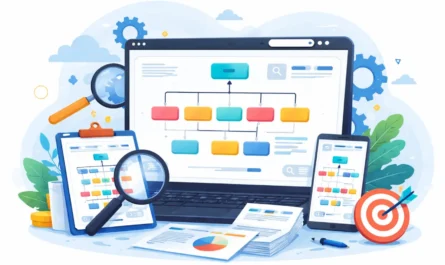

A single-page website is special, with all of your content existing at one URL rather than being scattered across many pages. Even though such an approach may be simple and very friendly for users, achieving high rankings for your one-page site with search engines like Google requires some well-thought-out SEO tactics that make it useful for visitors as well as to crawling robots.
1. Introduction
Single-page websites are very popular; they are especially ideal for small businesses, event pages, product launches, startups, portfolios and simple service sites. These sites provide a seamless user experience by keeping all information in just one URL and use anchor links like #services or #contact for navigation. However, this straightforwardness can pose an obstacle against search engine optimization meaning one must follow a defined plan in such a case.
2. What is a Single-Page Website?
A single-page website also called a one-page website shows all its key parts like Home, About, Services, FAQs, and Contact on one single page that you can scroll through for some time. The users do not change pages by clicking but rather they follow menu links which bring them to various divisions of that particular page. The clean design provided in this kind of site is usually meant to be focused towards making the conversion by guiding visitors through some particular storyline with a lead to a call to action.
3. Single Page Website Cons
While there are advantages, it’s important to understand the limitations and SEO challenges of a single-page site:
3.1 Limited SEO Opportunities
The website is accessible via only one URL so it is determined by only one collection of meta tags for example title, meta description and therefore there is a constraint of limiting the keywords that can be targeted with ease. Websites with different pages are able to customize every page based on what specific search engine users will input while those with single pages may use broad or similar related keywords only.
3.2 Harder to Compete for Many Keywords
Single-page websites are generally designed based on a central theme or subject matter. It is challenging for such website designs to help other services or products of your company to be recognized in search engines when they have many different things to offer.
3.3 Analytics Granularity is Limited
Monitoring a user’s actions and knowing which part of the content is most interesting requires an additional setup like scroll tracking in Google Analytics since every visit equates to only one page view.
3.4 Potential for Slower Loading
Even if your site uses a one-page design it may still be slowed down if it loads a lot of heavy content like images, videos, or even animations. Performance is very important for rankings and having a website with low speeds could also result in an increased bounce rate.
4. Single Page Website Pros
Despite the challenges, one-page websites offer real benefits especially when designed and optimized well.
4.1 Easy to Load and Fast Performance
Optimizing the site so that there are small sized images and also good code will make the one page site to have a fast loading speed and a very unique appearance. A faster loading rate is beneficial in the sense that it increases user satisfaction as well as improves the ranking in search engines.
4.2 Natural Mobile-Friendly Design
The traditional one-page scroll format fits mobile user behaviors very well. Users can easily swipe over content and enhance their mobile experience, and because search engines are biased in favor of mobile-friendly websites, this is an advantage that is realistic.
4.3 Easier to Create Using CMS and Templates
Platforms like WordPress, Wix, and Squarespace provide pre-made templates for a single-page site, thus making setup easy and maintenance fast with lower costs for newbies.
4.4 Strong Authority Concentration
As all backlinks lead to one url, all the SEO worth (Domain authority and Page authority) is gathered there rather than being dispersed on other subpages. With that, if you develop good-quality backlink structures, it may become easier for your principal page to be ranked higher concerning its key words.
4.5 Better User Engagement and Conversions
The one-page website guides the customer through linear flow starting with the problem leading to the solution then finally reaching at call to action. By doing this it eliminates unwanted distractions and it increases conversion rates with respect to calls sign up, and purchases.
5. How to Optimize a Single-Page Website
Here’s how to make your one-page design SEO-friendly and rank it effectively.
5.1 Check If the Website Is Divided Into Clear Sections
For ensuring that your website is friendly and is easy for search engines to crawl, then you have to divide it into clear sections that follow a particular order of logic. It could have typical sections that include the hero or introductory section, an about us, our services, customer reviews, a list of frequently asked questions (FAQ) section, and a contacts’ part as well. The use of HTML5 semantic elements like nav and header clarifies each section. With menu anchor links like #services, it’s very possible that they can help out the visitors as well as the search engines in identifying and getting familiar with structure of the given webpage very quickly. An organized design offers high usability levels, better access, and also good SEO.
5.2 Try to Rank Different Sections
In spite of having a single URL in a web page, every section can be optimized to several related keyword variants with aim of covering all possible search inquiries. Take an example whereby one part can concentrate on “Digital Marketing Services in Delhi,” while another one could have “SEO Services in Delhi,” and another one on “Social Media Marketing Packages.” When we can naturally include these kinds of keyword variations in headings, subheadings, and body text, then search engines will better comprehend the connection between every section for various search queries, thus increasing chances of being ranked in several associated search inquiries.
5.3 Try to Optimize Different Sections
Consider every part on a webpage as its own small landing page. Starting by providing a clear header, such as an H2 or H3, for every portion is good practice and include relevant keywords along with associated phrases within your content. The paragraphs should be short, user-friendly and also utilize bullets where it is possible so that readers may read easily. The outcome of this strategy is more than that; it not just makes it good for your website users but also gives the search engine spiders enough information regarding the topic covered in every given section of your web page which will, therefore, lead to an improvement of your site’s SEO performance.
5.4 Go for Multiple H1
While certain SEO sources may say to put multiple H1 tags on one-page sites imitating different pages, the most up-to-date recommendations say we should have just one chief H1 tag focusing on the theme of the whole webpage. Larger headings like major section titles are best denoted with H2 tags while smaller ones, i. e., subsections use H3 tags. By following this clear hierarchy, it’s easy for search engines to determine the organization and relevance of your content- which in turn enhances both SEO and overall usability for users.
5.5 Create In-Depth Content for Each Section
So that your website can be ranked best for competitive searches, every part of your webpage must contain detailed and good explanations on the subject matter, not shallow or superficial texts. Incorporate FAQs where you provide some answers, and also show some testimonies, samples, or case studies, and fully explain out the pros, characteristics, and answers given. By doing so with some level of details, your site will look deeper and relevant and thus aiding search engine in identifying its correct rank of competitiveness.
5.6 Optimize Technical SEO and Performance
Ensuring that your website’s technical SEO and performance are at their best serves both the comfort of the visitors and your chances of achieving good SERP rankings. A few of the tasks involved in this include reducing image sizes while using newer formats; minifying CSS and JavaScript codes and making sure that any content located below the fold can use lazy loading. And if you make use of a CDN (Content Delivery Network), it can assist in delivering content fast across all parts of the world. Additionally, tools such as Google PageSpeed Insights can find out about your page’s performance problems and give suggestions on how to enhance its load speed and overall SEO status.
5.7 Internal Linking With Anchor Tags
Even though you can’t link to separate pages, you can use internal anchor links to make navigation easy. For example:
<a href="#services">Our Services</a>This improves UX and helps search engines understand page structure.
5.8 Build Quality Backlinks
Obtaining high-quality back links is still key in terms of Search Engine Optimization for any kind of website including those with just one page. It is important that one uses some effective strategies which are, among others, writing guest posts on highly related sites and online resources where you can provide relevant citations and be listed in business directories as well as come up with some special data like infographic or research papers that people will want to share or circulate widely and then run very active social media campaigns. This leads into enhancing both page authority and credibility which further gives a boost to higher positions of your site on search engines.
6. Conclusion
Simple single-page websites really shine when designed to get one key message across and are optimized for search engines. They do have some built-in limitations – fewer chances to go after multiple keywords and less detailed analytics being examples but they also offer benefits such as quick load time, better mobile experience, simpler design, and strong authority focus.
It is possible for your single-page website to appear among top Google search results through some basic procedures which are structuring of your content into clearly defined parts, optimizing on performance of the website, targeting some related keywords that have varying forms, and making out high-quality backlinks.
Even a single webpage could have the potential of generating traffic, leads, and conversions if you implement the right online strategy that is very useful for most businesses in terms of building their presence on the web.