
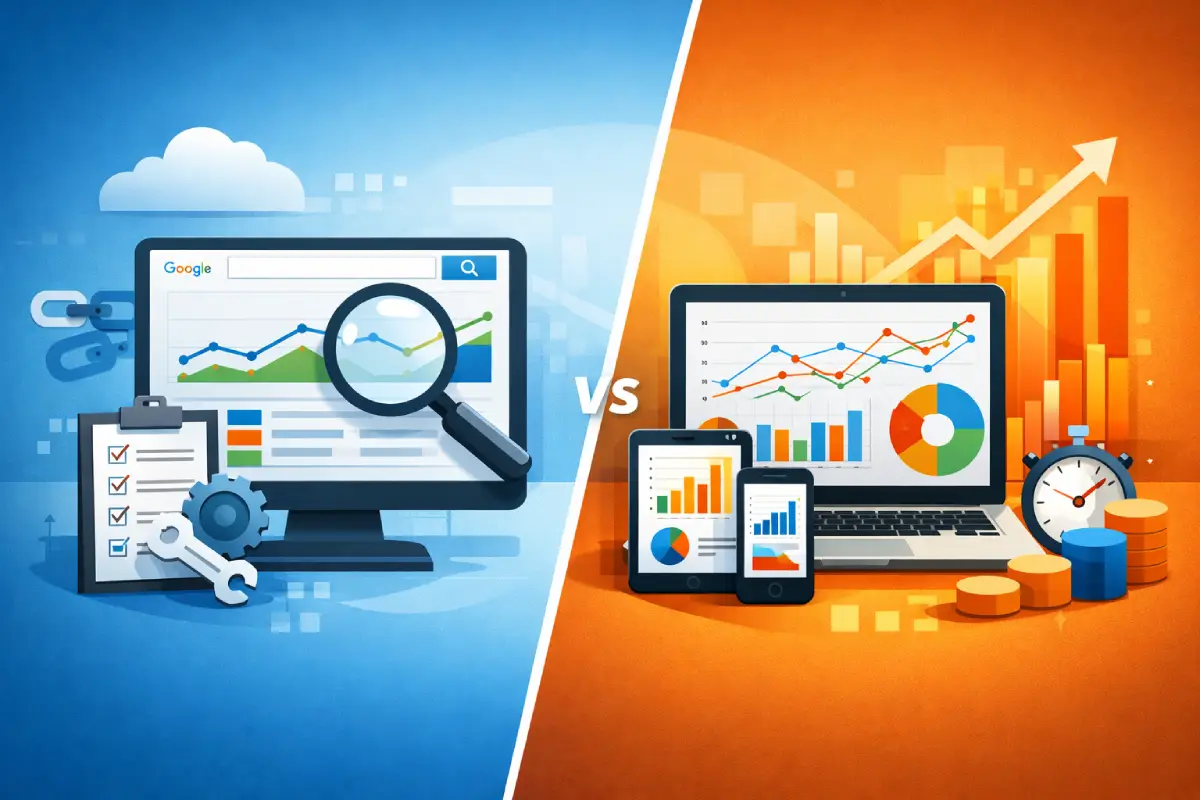
Running a website involves more than just putting up content on posts and pages. Understanding your site’s search performance and visitor behavior is equally vital. Google offers two free tools, Google Search Console and Google Analytics, each serving different functions. Google Search Console helps you understand how search engine crawlers interact with your website, showing indexing status, crawl errors, and performance reports. On the other hand, Google Analytics focuses on user interaction, providing insights into demographics, behavior, and conversions, so you can analyze how visitors engage with your site and optimize accordingly. Together they provide a complete picture of how your site performs as well as insights into the people who use it. Let’s get into Difference between Google Search Console and Google Analytics.
1. What is Search Console
1.1 Monitors Search Visibility
Google Search Console provides insights into your website’s performance in Google search results. It tracks how often your site appears (impressions), records the queries that generate visits, and verifies whether your content is indexed, all useful for enhancing your search presence.
1.2 Crawl and Index Insights
It details errors such as broken links or page crawl problems stopping Google from reading your site. Making sure search engines see all your key material which is vital for SEO.
1.3 Focuses on Technical SEO
Search Console offers tools to submit sitemaps, monitor mobile usability, and view page experience updates. It gives feedback directly from Google about your site’s structure. These insights help improve site quality.
2. Search Console Benefits
2.1 Keyword Tracking
You can see which search queries bring users to your site. It also reveals your page’s appearance frequency and click count. This data proves useful for refining content and enhancing its position.
2.2 URL and Sitemap Submission
If you publish new content, you can submit URLs for quicker indexing. By ensuring your updates reach users quickly, this proves particularly beneficial for time-sensitive content or campaigns.
2.3 Mobile Usability Reports
Search Console identifies mobile issues like small text or elements that are too close together. Fixing these improves user experience on mobile devices. It also aligns with Google’s mobile-first indexing.
2.4 Security and Manual Action Alerts
If Google detects any hacking attempts or spam, you’ll receive a warning. It also alerts you about manual penalties. Taking quick action protects your site from visibility loss.
3. Search Console Limits
3.1 Only Google Search Data
Search Console only shows organic traffic from Google. Occasionally, users may visit your site from a direct link, a social-media profile, or Bing– but this tool won’t record those visits. For an in-depth understanding of your web traffic patterns it’s best combined with other analytics software.
3.2 No Real-Time Reports
Data in Search Console updates with a delay of one to two days. This makes it unsuitable for monitoring live traffic or quick campaign results. Time-sensitive tracking requires another platform.
3.3 Limited User Behavior Insights
It doesn’t show what users do on your site after they arrive. There’s no information on bounce rates or pageviews. For that level of detail, you’ll need Google Analytics.
4. What is Google Analytics
4.1 Tracks User Activity
Google Analytics gives you insights into how visitors behave on your site. It gathers data such as which pages are viewed, how long people stay, their navigation paths, and other interactions enabling an assessment of whether your content is doing its job.
4.2 Shows Traffic Sources
You can tell if visitors come from search engines, social media, paid ads, or other websites. Knowing this helps guide your marketing efforts and shows you which channels are working best.
4.3 Audience and Conversion Data
Analysis reveals patterns and preferences in users and also tracks important actions such as purchases or sign-ups. In turn, this information offers a fresh perspective on how well your company is doing.
5. Analytics Benefits
5.1 Real-Time Tracking
Monitoring the current online visitors and their locations allows you to see how many individuals are engaged with your website right now. This data is especially useful when unveiling new campaigns or content as it enables swift decisions based on concrete information.
5.2 Demographic and Device Insights
Analytics shows you the ages, genders, and locations of your users as well as the kind of devices they’re using. Knowing this helps you improve both site design and content. For example if lots of visitors arrive via mobile phones making sure pages work well for them is essential.
5.3 Bounce and Engagement Metrics
You are able to monitor the popular pages and identify those from which visitors exit rapidly. This information enables you to enhance the design, headlines, or overall clarity of your content. Reducing bounce rate leads to better retention.
5.4 Goal and Conversion Tracking
To figure out which pages or campaigns are most effective, set and monitor objectives. You may want to keep track of form completions, newsletter signups, or product purchases– it’s all up to you! It’s vital for ROI analysis.
6. Analytics Limits
6.1 Complex Interface
In the beginning, Google Analytics appears overwhelming due to its many features. One cannot just jump into using it; one has to take time studying the reports in order to make sense of them. But once you have learned your way around– wow! It is an incredibly powerful tool.
6.2 Requires Setup
You need to install a tracking code on your website. If not installed properly, data may be inaccurate. Unlike Search Console, Analytics doesn’t work automatically.
6.3 Privacy Compliance Needed
Since Analytics collects personal behavior data, privacy laws apply. You must display a cookie banner and get user consent. This adds legal and technical responsibilities.
7. What They Have in Common
7.1 Both Are Free
Search Console and Analytics are completely free tools from Google. They’re accessible to anyone with a website. Despite being free, they offer professional-grade insights.
7.2 Improve Website Performance
Both assist site owners in making more intelligent choices. One enhances visibility on search engines while the other increases user engagement; used together they promote long-term growth.
7.3 Connect with Google Services
Due to integration with platforms like Google Ads and Data Studio, one can create visual reports or marketing dashboards using these tools. Additionally, this integration enables a smoother workflow.
8. Key Differences
8.1 Focus Area
Search Console shows what happens before visitors reach your site via Google Search. Analytics reveals their behavior once there. Both tools provide insights into different stages of the user journey meaning they are better used together than separately.
8.2 Traffic Coverage
Search Console only shows data from Google organic search. Analytics tracks all types of traffic search, social, paid, and referral. This gives a more complete picture of site activity.
8.3 Data and Timing
Analytics offers real-time data and behavior insights. Search Console updates slowly and focuses on technical performance. They’re both useful but for different needs.
8.4 Setup Process
Search Console is easy to set up by verifying domain ownership. Analytics requires installing code and more technical steps. Both need to be configured properly for accurate data.
9. Why Use Both
9.1 Complete Performance View
When you combine these tools, you get the complete picture as well as an understanding of why people visit your website and what they do there. This can lead to better decisions about content, SEO and website design!
9.2 Stronger Strategy Building
Incorporate key insights from Search Console into your writing, and then monitor user engagement through Analytics. This natural cycle allows for continuous improvements to be made to your approach making it more effective over time!
9.3 Smarter Problem Solving
By utilizing these tools together, you can identify trends that would have gone unnoticed.If your search traffic decreases or bounce rates increase, you’ll be able to find out why more quickly.
9.4 Better Results
The tools provide certainty that supports expansion through the use of verified statistics rather than mere speculation, whether your goals include increased web traffic, higher engagement levels, or greater sales volumes.
10. Conclusion
Google Search Console and Google Analytics: these aren’t just tools; they’re a powerful duo giving insights that really click together. Using both platforms means you can bring more visitors through search engines and keep them interested when they get there. You find out what’s working, what needs improvement, and how to match your SEO efforts with real user behavior.
This dual approach leads to smarter content strategies, better user experiences, and stronger results– more traffic, higher engagement, and indeed more conversions too. For anyone wanting to build a genuine online presence combining the strengths of both tools is not just helpful; it’s absolutely essential.
For the latest Latest Tech News Today, AI tools, digital marketing insights, SEO updates, and Google algorithm changes, follow GhostPerks.com and Subscribe to our Newsletter.