
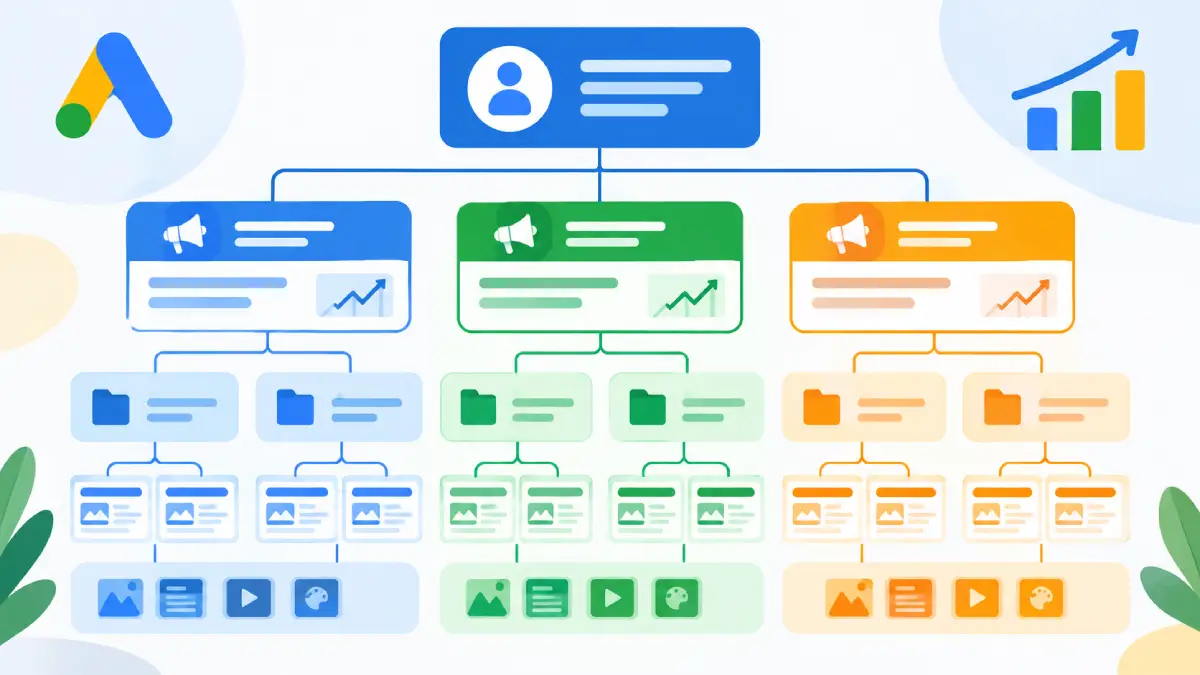
Google Ads account structure is the way your advertising is organized, from the top-level account down to individual ads. Google uses several levels so that budgets, themes, messages, and additional details each have a clear place. Once you understand how these levels connect, it becomes easier to know where everything belongs inside an account. The structure also varies by campaign type, so it is not identical everywhere.
1. Google Ads Account Structure at a Glance
A Google Ads account works like a filing system. Each level has its own purpose and helps organize the level below it.
- Account: The overall container for your advertising.
- Campaigns: Major groups of advertising activity, each with its own settings.
- Campaign types: The type of campaign, such as Search, Shopping, or Performance Max.
- Ad groups: Themed groups used to organize ads and, where applicable, keywords within a campaign.
- Ads: The advertising messages people see.
- Assets: Additional information or creative elements that support ads.
- Campaign-specific structures: Additional organizational elements used by certain campaign types, such as asset groups or product groups.
The general pattern looks like this:
Account → Campaign → Ad Group → Ads + Assets
However, this is a starting point rather than a structure that applies identically to every campaign type.
2. The Account Level in Google Ads Account Structure
A Google Ads account represents your business or advertising presence within Google Ads. It sits at the top of the hierarchy and contains everything else. One account can contain multiple campaigns. This makes the account the overall container for your advertising activity.
Some areas are managed at the account level, including:
- Billing: How payments for advertising are managed.
- Access: Which people can view or make changes in the account.
- Account-wide settings: Settings that apply across the account rather than to one specific campaign.
Everything you create within Google Ads belongs to this overall account structure.
3. Campaigns in Your Google Ads Account Structure
A campaign is a group of related advertising activity within your account. It is an important organizational level for separating major advertising activities from one another. For example, a business might use separate campaigns for different products, services, or advertising objectives. Each campaign can then have its own settings.
Common campaign-level settings include:
- Budget: The amount allocated to the campaign.
- Bidding: The approach used by the campaign when competing for ad placements.
- Location: The geographic areas associated with the campaign.
- Language: The languages selected for the campaign.
These settings are important to the structure because they apply to the campaign and the elements organized within it. When different advertising activities require different campaign-level settings, separate campaigns may be appropriate.
4. Campaign Types and Their Structures
Every campaign has a campaign type, which determines the advertising format and influences the structure available inside the campaign.
The main Google Ads campaign types include:
- Search
- Display
- Shopping
- Video
- Demand Gen
- App
- Performance Max
Note: Different campaign types can have different internal structures.
For example:
- Many campaign types use ad groups to organize related advertising themes.
- Shopping campaigns can use ad groups along with product groups for product organization.
- Performance Max uses asset groups rather than traditional ad groups.
Google is also changing how some visual advertising options are organized, including the relationship between Display and Demand Gen. The exact options and structure available in an account can therefore change over time.
5. Ad Groups in Google Ads Account Structure
Ad groups are one of the most important parts of Google Ads account structure. An ad group is a container within a campaign that organizes ads and, in many campaign types, related keywords. The main purpose of an ad group is to organize a campaign around a specific theme. A theme might be a product, service, category, or closely related group of offerings. Keeping an ad group focused on one theme makes the campaign easier to understand and manage.
5.1 Using Your Website to Find Themes
Your website can provide useful clues for organizing ad groups. Categories, products, services, and individual pages often reflect the way your business is already organized. For example, an online store might have separate sections for running shoes and hiking boots. These represent different themes that could help shape the structure of the relevant campaign. The goal is not to copy every website page into an ad group. Instead, the website can help identify logical themes that make sense for the advertising structure.
5.2 Keywords Inside a Theme
In campaigns that use keywords, closely related keywords can be organized within an ad group based on its theme. Different keyword match types can also be used within a themed ad group where appropriate. The important point for account structure is that the keywords should relate to the same overall theme.
5.3 Ads Follow the Theme
The ads within an ad group should be relevant to that group’s theme. For example, if an ad group focuses on running shoes, the ads should communicate information related to running shoes rather than an unrelated product. This creates a clear relationship between the ad group’s theme and the ads associated with it.
5.4 Which Campaigns Use Ad Groups
Ad groups are used in many Google Ads campaign types, but the structure is not universal. Performance Max is a major example of a different structure. It does not use traditional ad groups and instead uses asset groups to organize creative assets around themes or other campaign needs.
6. Ads in Google Ads Account Structure
An ad is the advertising message that people see. It communicates what you are promoting and provides information that can encourage people to engage. Where ad groups are used, ads are organized within them. The ads should match the theme of their ad group. For example, an ad about hiking boots would make more sense in an ad group focused on hiking boots than in an ad group focused on running shoes.
Ad formats and structures can vary by campaign type. Search advertising primarily uses text-based formats, while other campaign types can use combinations of images, video, text, and other creative elements. The basic role remains the same: the ad delivers the advertising message within the campaign structure.
7. Assets in Google Ads Account Structure
Assets are additional pieces of information or creative that support your ads. They can add useful details or functionality beyond the main advertising message.
Common examples include:
- Sitelinks: Additional links to specific pages on a website.
- Callouts: Short phrases that highlight important information.
- Structured snippets: Information presented as predefined categories or lists.
- Images: Visual elements that can support eligible ads.
- Calls: Options that can help people contact a business by phone.
- Promotions: Information about special offers.
Depending on the asset and campaign type, assets can be associated with different levels of the account structure. Some assets can be used at the account level, while others can be associated with campaigns or ad groups. In Performance Max, assets are organized through asset groups.
The Difference Between an Ad and an Asset
An ad is the main advertising message. An asset is an additional piece of information or creative that can support that message. For example, an ad may contain the primary headline and description, while a sitelink can provide an additional route to another page on the website.
8. How Google Ads Account Structure Works Together
The different components work together, but the exact hierarchy can vary by campaign type.
8.1 Search Campaign
Account → Search Campaign → Ad Group: Product A → Related Keywords + Ads + Assets
Here, the ad group provides the theme, related keywords support that theme, and the ads communicate the relevant message.
8.2 Performance Max Campaign
Account → Performance Max Campaign → Asset Group → Assets
Performance Max uses asset groups instead of traditional ad groups to organize creative elements.
8.3 Shopping Campaign
Account → Shopping Campaign → Ad Groups → Product Groups
Shopping campaigns use ad groups and can further organize products through product groups. These structures are different because campaign types have different ways of organizing advertising elements. The account remains the top-level container, while the structure inside each campaign can change.
9. Common Google Ads Account Structure Mistakes
Beginners can run into several structural misunderstandings:
- Treating every campaign type as having the same structure: Some campaign types use ad groups, while others use asset groups or additional structures such as product groups.
- Creating ad groups without a clear theme: An ad group without a clear theme loses much of its organizational purpose.
- Mixing unrelated topics or keywords in one ad group: Unrelated themes can make a campaign harder to organize and manage.
- Confusing ads with assets: Ads deliver the main advertising message, while assets provide additional information or creative.
- Confusing ad groups with Performance Max asset groups: They are different structures used for different purposes.
- Creating unnecessary structural complexity: Too many campaigns, ad groups, or other organizational layers can make an account harder to understand.
10. Key Takeaways on Google Ads Account Structure
- The account is the overall container for your advertising.
- Campaigns organize major advertising activities.
- Campaign type influences the structure available inside a campaign.
- Ad groups organize themes where they are supported.
- Ads communicate the main advertising message.
- Assets provide additional information or functionality.
- Some campaign types use different structures, such as asset groups and product groups.
11. Conclusion
Google Ads account structure provides a way to organize advertising from the account level down to campaigns and the elements within them. Ad groups help organize themes where they are supported, while ads and assets provide the messages and additional information used within campaigns. Because campaign types can use different structures, understanding these relationships helps you recognize where each part of a Google Ads account belongs.